Many of the stories that have been written about the pioneers arriving in this area have stated that they left their ancestral homes and came to this "New Land." Actually, it was a very "old" land, and although humans had lived from this land, it was virtually an "un-used" land. The term "New Land" applied only to the extent that the pioneers were the first to establish permanent homes and till the soil.
The findings of stone-age tools and fossils in the same strata of earth by archeologists has enabled scientists to establish that perhaps as long as twenty-five thousand years ago the First Americans may have passed through, or stopped in this area. It is believed that they came across the Bering Strait from northern Asia and eventually formed a thin population across the North American continent. Scientists believe they were the founders of the Algonquian race which were later prevalent in eastern America. At some time later, a second wave of Asiatics came by the same route, establishing a race on this continent that we know today as Eskimos. There were vicioi s wars between these two races, but this latter group was only partially successful in dominating any one area.
Later, about the time of Jesus of Nazareth, a third wave of humans known as Athapascans came by the same route from the Himalayas. They were fierce and aggressive and made war on the first two groups for many years. From this group came the Navahos and Apaches.
There were other lesser invasions of people from other lands, and from all these groups and the inter-marriage between these groups which eventually occurred, have come the many Indian tribes in America. Although the Indians had lived here for perhaps a few hundred years before the pioneers arrived, about the only natural resource which had been depleted in this area was in the case of the buffalo.
Scientists tell us that thousands of years ago an arm of the Gulf of Mexico extended north across central United States and part of Canada. At that time, most of North Dakota was below sea level, and so, most of the state was covered by this shallow sea. This water receded and returned again several times. When the waters receded, the area was covered by dense vegetation and there was animal life. When the waters returned, the vegetation and the animals which could not escape died. These layers of dead plant and animal life were therefore deposited on the "old" surface of our state. In addition, rivers flowing into this sea also deposited layers of silt. There were also upheavals of the earth, and all these factors contributed to the deposit of layers upon the "old" surface, until today, most of our state is somewhat less than one-half mile above sea level. These occurrences also contributed to the uneven topography of our state. The proof of all this can be found in the fossils which have been discovered. Fossils can be the imprint of plant or animal life on rocks, or in mud which later hardened. In the case of petrified trees which can be found in western North Dakota, while these trees were submerged under water, the cells were slowly replaced over a long period of time by a hard mineral called silica. The imprint of plant and marine life can be found in the shale which is so prevalent in the coulees near Milton.
Our land underwent further changes during the glacial age. Climatic changes brought about the colder climate that led to heavy snowfalls and less melting. Glaciers began to form in Canada and grew in size until this huge glacier reached as far south as Nebraska. When the weight of this glacier became great enough, it began to slowly move in a southerly direction. It gouged and pushed enormous quantities of soil and rocks before it as it slowly moved southward, and in the process deposited and spread this material called "glacial drift" over our land. Scientists believe this glacier may have gouged and deepened the part of North Dakota which we know as the Red River Valley, and perhaps reshaped the rest of the surface of North Dakota as well.
As warmer conditions returned, the glacier began to melt and the water flowed south to the Gulf of Mexico. The Red River Valley slopes gently to the north at the rate of about one foot per mile, and so when the southern edge of the melting glacier had receded to what is now North Dakota, the southern flow of water from the glacier slowed and finally stopped. The water began to accumulate since the glacier blocked it from flowing north and the result was the formation of Lake Agassiz, as well as Lake Souris. These lakes existed until the glacial barrier finally melted, permitting the waters of Lake Agassiz to flow north, eventually reaching Hudson Bay. Today, the Red River, which constitutes the boundary between North Dakota and Minnesota, continues to drain this old lake bed and is known as the Red River Valley.
As stated before, as the glacier formed and grew in Canada to such size that it began its southern movement, it carried with it vast amounts of soil and rock called glacial drift. As the glacier moved south, and then receded due to the melting, this "gift from Canada" was slowly deposited in varying amounts on top of the Pierre shale. As the glacier slowly melted, there were times when the rate of melting at the southern edge of the glacier was equal to the southern movement of the glacier, and this resulted in greater amounts of this "drift" being deposited at these points. When one observes the sheer shale banks in our area, it is easy to see the layer of glacial drift that was deposited on top of the shale.
North Dakota, which comes close to being a perfect rectangle, contains 70,665 square miles. It is 335 miles long and about 210 miles wide.
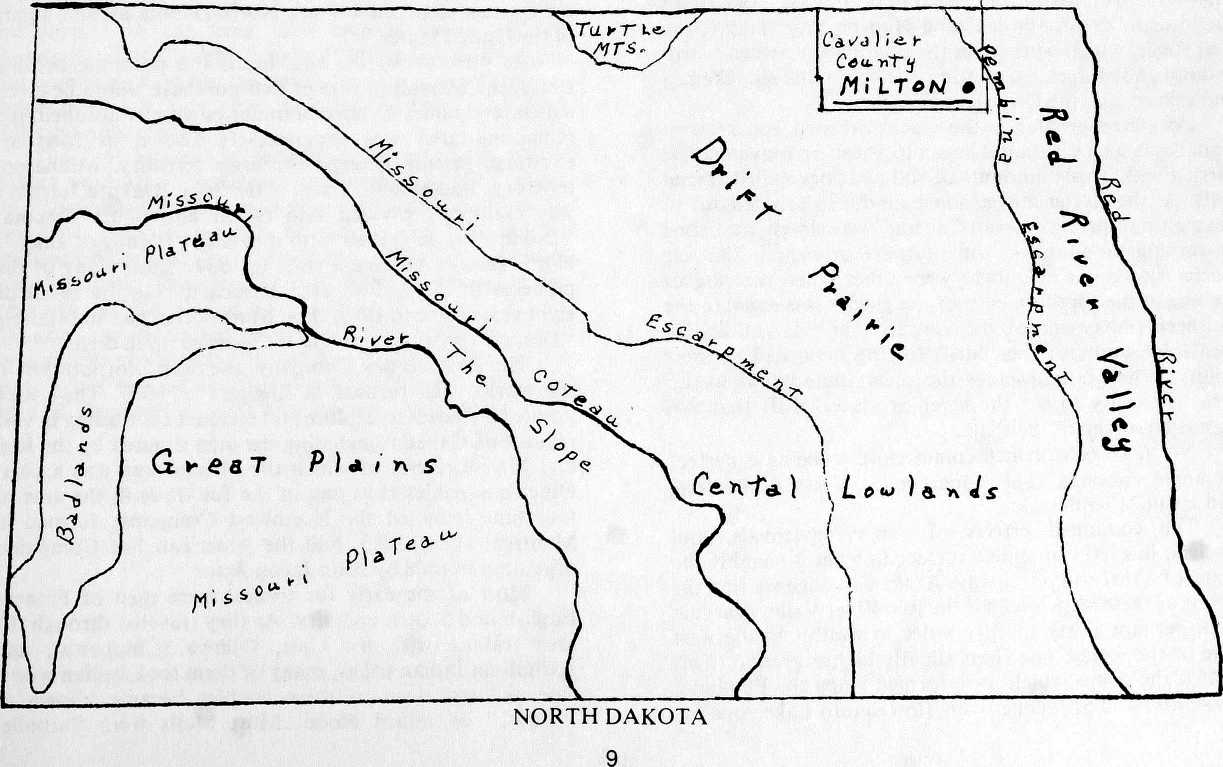
The combined effects of water, upheavals, and glaciers, has left our state’s surface in what is roughly the shape of a three-step stairway. At the east edge we find the lowest of these steps which is the Red River Valley, varying from perhaps thirty to fifty miles in width. At the west edge of the valley, one finds slightly higher ground. This shelf is the deltas which were formed when the Pembina, Park, Elk, and Sheyenne rivers flowed into Lake Agassiz.
As the water from these rivers flowed into the lake, the flow slowed and the heavier particles carried by the water dropped first and the lighter particles last as the flow finally stopped.
At the west edge of these deltas is the wooded Pembina escarpment, where the elevation increases as much as three hundred feet or more. An escarpment has been described as a "one-sided hill." Once you have climbed to the top of this "hill," you arrive on a plateau or plain and there is no "down-hill" on the other side.
It is on this plateau or drift plain where Milton is located, about four miles west of the Pembina escarpment. This drift plain, very wide at the Canadian boundary and narrowing to the southeast, is the second of the three "steps" of our state and meets to the west with the Missouri plateau, or third step.
When LaSalle discovered the Mississippi on April 9, 1682, he claimed all the land drained by the Mississippi and its tributaries for France. Since the Missouri was one of the tributaries, and drains roughly the southwest half of North Dakota, this area then became the property of France. Later, the need for money led France to sell this land by treaty to Spain and in 1800, by treaty, Spain returned this land to France.
By this time, England had claimed the land to the north including the area drained by the Mouse and Red rivers, and so, the northeast half of North Dakota became their property. In 1804, United States purchased Louisiana from France for fifteen million dollars and on October 20, 1818, the treaty with England established the 49th parallel as the boundary between United States and Canada. Thus, the entire area of what is now North Dakota became a part of the United States.
As portions of the vast Louisiana purchase became states, the remaining part of that purchase would be given a different name. As state boundaries were established, the remaining area was progressively known as Missouri territory, Michigan territory, Iowa territory, Minnesota territory, and finally, Dakota territory. Dakota territory was eventually divided into North and South Dakota. "Dakota" is an Indian term meaning "friends or allies." North Dakota became a state in 1889. Since many of the pioneers in the Milton area arrived during the seven or eight years prior to 1889, their trunks often had the address "Dakota Territory," or "D. T." carved upon them.
The Hudson Bay Company, the oldest corporation in the world, was formed in England in 1670. They were granted a charter to explore and conduct fur trading in vast regions of Canada, including the area drained by the Red and Mouse rivers, of which the Milton area was a part. Other companies engaging in the fur trade in the area at that time included the Northwest Company, formed in Montreal about 1783, and the American Fur Company, organized in 1808 by John Jacob Astor.
Most of the early fur traders were men of French, English and Scotch ancestry. As they traveled through the area trading with the Cree, Ojibwa (Chippewa), and Assiniboin Indian tribes, many of them took Indian wives. The children born to these couples became known as "Metis," or mixed blood. Most Metis were Catholic, spoke a dialect of both European and Indian languages, and quite often wore European style clothes. They were excellent hunters, trappers, and horsemen, and were fiercely proud, considering themselves to be a "New Nation" of people. Although some did a little farming, they lived primarily by hunting the buffalo, not only for the meat and hides for their own use but also to trade the hides and the "Pemmican" which they made from the meat to the trading posts for other necessities. Although the Sioux Indians may at one time have considered the Milton area a part of their domain, they were slowly driven or moved further west and south by other tribes and the influx of the whites into the area. The depletion of the great herds of buffalo in this area, caused by excessive slaughter by both Indians and whites, caused the Metis and Indians to eventually move west to the Turtle Mountains. Thousands of buffalo were slaughtered by professional buffalo hunters merely for their hide and tongue.
One of the first, if not the first white man to view part of North Dakota, was the French explorer, Pierre Verendrye, and his exploring party, who according to historians, entered what is now North Dakota on October 18, 1738, near or on this side of the Turtle Mountains.
While the western part of North Dakota was being explored by Verendrye, Lewis and Clark, David Thompson, and Manuel Lisa, all of whom were early explorers of the area, the first actual trading post established within the present boundaries of North Dakota was at Pembina. It was established there in 1797-98 by Charles Chaboillez, representing the Northwest trading company. It had disappeared by the time Alexander Henry came up the Red River in 1800. Henry built his first post at a point where the Park River joins the Red, but since this was near the Sioux Indians’ territory, he later abandoned this post and built another at Pembina. He had great success raising vegetables, so he might be called the first real farmer in the area. His records spoke of the abundance of wild game, including black bears and elk. He also commented on the tall, thick, prairie grasses and the danger of prairie fires when these grasses dried at the end of the growing season.
The first attempt at settlement by whites in North Dakota was by the "Selkirkers" at Pembina in 1812. These were Scotch and Irish people who had been evicted from their land in those countries by rich landowners because they wanted the land for raising sheep. A Scotch nobleman named Thomas Douglas, Earl of Selkirk, felt sorry for these evicted people and he secured a block of land in Manitoba and the northeast corner of North Dakota where these people could settle. Since they thought there would be more buffalo and game in North Dakota for food, they came to Pembina in 1812 and started a settlement, but within the year they returned to Manitoba, settling in the Winnipeg area.
In 1844, Antoine Gingras, a Metis, established a fur trading post near the present site of Walhalla and worked and traded mostly for the Hudson Bay Company. He also operated Red River ox-cart trains from Winnipeg to St. Paul. Norman Kittson also established a trading post at Pembina in 1851, but due to flooding there in 1852 he moved his post to the Walhalla area.
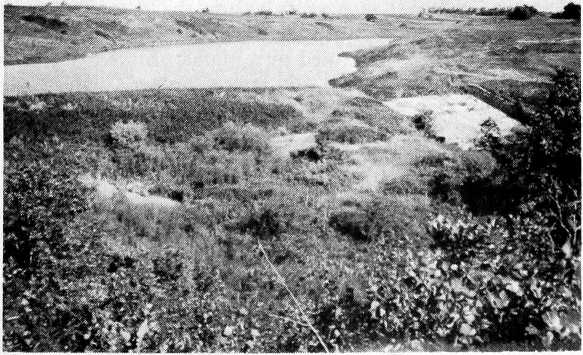
What did this area look like before the pioneers arrived and settled? Early explorers stated that the timber was mostly along streams and in the Pembina Hills. The prairies were an endless rolling sea of tall, dense grass. Of course, the entire area was unmarked by roads, power lines and buildings such as we see today. The only sign of the presence of humans was an occasional Indian trail. One of these trails passed just north of Milton near the C.C.C. dam, and was referred to by the pioneers as "The Indian Crossing." Settlement of this area was slow due to several factors. Stories about the cold and severe blizzards and Indian uprisings kept people from coming for some time. Also, the lack of transportation into the area was partly responsible, and by 1870 only one man, Joseph Rolette, who claimed land at Pembina, had filed a claim.
At that time it was also necessary to journey 400 miles south to Vermillion to file a claim. However, by 1871, twenty-eight more claims had been filed in the Pembina area. By 1885, the railroads had entered into North Dakota and this resulted in a flood of pioneers coming to the area.
Milton is located in Cavalier County of North Dakota. The county is named in honor of Charles Cavileer, who in 1851 was a customs collector at Pembina. Cavalier County at one time in the early history of the state was a part of Pembina County and its boundaries were changed more than once before the present lines were established.
The first Milton post office was located two miles east of the present site of Milton, on the north edge of the coulee. Established in 1882 by a Donald McDonald, there are two stories as to the origin of its name. One report states it was named by a man who had come from Milton, Ontario, and the other story which has been accepted and documented in previous historical accounts, states that it was named in honor of the great poet, John Milton, by Mr. Donald McDonald. The post office was moved to the present site of Milton when the railroad reached there in 1887.
A great deal more could be written about the geology and history of this area. However, we present this article as a brief summary of facts pertaining to the pre-settlement age of this area. This, then, was the "New Land" to which our pioneering ancestors came!
Written by Charles Stabo
Towards the end of the summer of 1883, a party of English people — men, women, and children — might have been seen leaving Grafton, N. Dak., and wending their way west in search of new homes on the then almost trackless prairie. In the Grafton they left behind them, it would be difficult to trace the thriving and up to date city of today. Its streets were of mud or sand, according to the weather, no sidewalks with the exception of a wooden platform here and there in front of the stores, a couple hotels and livery stables, a court house, two or three elevators, (for it was even then an important wheat growing district), and a few residences scattered here and there. Such is a tollerably correct picture of the Grafton of over 30 years ago. I must not fail to mention its widely read newspaper edited by a real live man, well acquainted with the requirements of his cosmopolitan community. But, I hasten after my teams, already on the way.
A lovely morning, such as can only be seen on the broad prairies of the northwest, greeted us as we passed through the flourishing and well settled village of Kensington — over the site of the present city of Park River, and on to the Golden Valley, in which was the thriving town of Garfield, sprung up like a mushroom in anticipation of a railroad, which alas, never came. The town consisted of several well-filled stores, a blacksmith shop, a printing office, and a hotel — where we decided to spend the night, as our animals were tired from the long and heavy pull.
The hotel was about as good as one could expect under the circumstances, built of rough lumber, you could put your fingers between the unpapered partitions of the bedrooms and privacy was impossible, but we were not over fastidious and slept soundly till daylight next morning. Before leaving, I paid my respects to the editor of the Garfield Times in his sanctum which was about 10 x 12, holding a stove, a couch, editorial chair and desk, and a printing press which took up the remaining floor space. The paper was a welcome visitor at many a lonely home. On this morning the editor was hard at work booming up in perspective the largest city of the great northwest, which, however, never materialized.
I may as well bid adieu to Garfield right here. A few months later, having occasion to visit Grafton, we took the same route intending to make Garfield our stopping place for the night. We entered the beautiful Golden Valley, but where was the embryo Chicago of the northwest? We strained our eyes in vain. Bye and bye we came to its site as evidenced by a number of cellar holes, a piece or two of broken lumber and a few scattered pots and pans here and there, but literally not a stick or a stone remaining one upon another of the coming famous city, conjured up by the fertile brain of the look-ahead editor.
Upon making inquiries we found that the Great Northern Railway Co., without so much as consulting the citizens of Garfield, had located their line several miles east of the Golden Valley and laid out the site of the present city of Park River. After mature consideration the discomforted citizens of Garfield came to the wise conclusion that as the mountain would not come to them, they had better go to the mountain, and so carted their stores and residences just as they were, on wagons, wheels and roller, across the prairie to the new town where many of them succeeded in becoming wealthy and enterprising citizens.
But, I must resume my narrative. After our first night at Garfield, with the early dawn we were on our way again — the ladies and children leading with a horse team, my father and I following with the lumber for our new house, drawn by a yoke of oxen, the first time we had driven those patient and long suffering animals. An ox fell lame, compelling us toward evening to rest and hire oxen at the farm of a hospitable Scandinavian, whose log house was on a big coulee, the south branch of Park River. The sun had sunk behind a very threatening bank of clouds before we were again on our way, guided by the evening star which we were advised to steer for. Flashes of lightning and mutterings of thunder portended a violent storm, which soon burst upon us with a fury which I never experienced before or since, even in the state of North Dakota. I realized, too, in some measure, what a darkness which might be felt was really like. Had it not been for the frequent lightning we could not have moved, for the heavy rain had converted the prairie into a lake. We were drenched to the skin and the poor oxen seemed completely bewildered by the deafening noise of "heaven’s artillery." Discerning through the blackness a faint light, towards which we urged our tired animals, we soon found that it came from a dwelling house in course of erection. It was as I afterwards found out the new store of the late John Strate. Both he and Mrs. Strate gave us a kindly welcome, took charge of our cattle, gave us hot coffee and made us as comfortable as circumstances would permit. For the house was both roofless and windowless. We laid down on a bed under the shelter of two loose slanting boards and were soon soaked through and through, as the storm continued unabated during a greater part of the night.
Being anxious about the other members of our party, we were up at daybreak. It was Sunday. The storm had ceased and we were soon on our way over the still flooded prairie, crossing running creeks and through sloughs, keeping in view our goal — a house and buildings still some miles distant. We reached it before noon — a sorry spectacle, to the mutual pleasure and thankfulness of all. Our dear ones had spent an anxious and sleepless night but powerless to render any assistance. Indeed they had their own troubles for a part of the house had been unroofed by the violence of the storm and they had found it difficult to find a dry spot for the beds.
After a few simple remedies and a long sleep we awoke, feeling not one bit the worse for our experience but, my first night on the Pembina Mountains is not likely to be forgotten.
A vacant "80" being available near the present town of Milton, we at once took possession and commenced erecting a dwelling. Before finishing we found to our dismay, that through some miscalculation we were short the whole of the lumber for one end of the building.
We were busy building stables, digging wells, cutting hay, etc., so we could not possibly spare the men and oxen to go 80 miles for a few boards. We therefore managed, with the aid of quilts and blankets, to keep tolerably comfortable for a week or two, the weather fortunately being very fine.
The only visible track at that time was an Indian trail which crossed the coulee at what is now known as Meling’s Crossing and was used by Indians visiting each other between Devils Lake and northern Minnesota. It had probably been used for ages as shown by the deep ruts made by their two-wheeled carts. At this time they met, I think, once a year for their ghost dances, which about that time were discontinued, as the meeting of the tribes was considered a source of fomenting dissatisfaction against the government.
The earliest religious services were held in the settler’s houses by an old gentlemen, a Methodist, who was drawn over the country by an ancient horse, a more antique vehicle of the one horse shay type. He was always a welcome visitor and served cheerfully for the small pittance collected from his poor congregations for his support.
A well known farmer, residing still upon the same farm, told me the following amusing incident. The old minister had started shortly after the sunrise upon his travels and coming to the place where my friend was breaking, waited until he came up, when the following conversation took place.
"Good morning friend," was the minister’s greeting. "Good morning sir," replied the farmer, "we are early birds." "Yes," was the answer, "I need be early for I am seeking lost sheep on this broad prairie." "Well sir," said the farmer, "you can take my word for it, you won’t find any around these parts. I have been here since sunrise and not a sheep has been in sight." The good old man explained his meaning and after sowing some good seed resumed his journey.
One of my earliest experiences — a pathetic one — comes to my recollection. A little motherless boy had died at the home of a kind neighbor — his mother having preceded him but a few months. In the absence of a minister, I was asked to bury him. The day was Sunday — a cloudless sky and towards evening, with a few others, I was standing by the side of the little, newly made grave, close beside his mother’s, on the raw prairie, far from any residence, when there appeared coming over a slight eminence a long procession of vehicles of every description, drawn mostly by oxen, clearly silhouetted against the dying rays of the sun which was just setting, each object as clearly cut as if carved in stone. We assembled around the grave, probably a hundred or more, sang a couple of hymns and I read the beautiful service of the Episcopal church. Strong men with loving hearts lowered the little waif into his long home, amid the subdued sobs of the women. After introductions and handshaking we went our way to our respective homes, leaving mother and boy side by side, where they still lie in God’s good keeping, safe as if buried in the grandest mausoleum. Truly, "one touch of nature makes the whole world akin."
Our first crop on rented land was a complete loss, through early fall frosts, which prevailed off and on for several years. The yield was good, but there was not much satisfaction in receiving 25 cents or 30 cents a bushel for damaged grain, after hauling 30 or 40 miles with oxen. Many of the settlers grew disheartened and left. We, who were strangers in a strange land, had no better prospect in view, but stuck to it and eventually won.
Old Milton consisted of a store in which was the post office, two miles east of the present site, and served with a tri-weekly service from St. Thomas. The township (Hummel), named after an early settler, being unwieldy, was divided into Alma and Mount Rose — not Montrose. I was elected the first clerk of the latter township. We, at Milton, never expected the railway to come nearer than six miles south of us because of the big coulee at what is now Union, but the road builders made light work of that obstruction, and to our surprise, the fall of 1887 saw the track laid and the first train appeared in the Pembina mountain plateau. The first building was placed in the midst of a fine field of golden grain, just ready for the sickle, and was, of course, that almost universal pioneer of western civilization — a saloon. Other flimsily built stores followed and soon business was in full swing. The town was not yet laid out, but it was no hard matter to remove, when the site was agreed upon. We retained the name Milton and the post office was removed to its present situation. With the advent of the railway things moved rapidly. Merchants commenced business, a bank was established, elevators, a hotel and several private residences were erected, and a thriving town arose.
In due course of time an efficient town board was elected together with other officers. To my lot fell that of justice of the peace.
I must just give you a glance at my first "court." It was in an unfinished room over a saloon. The window holes sashless, a few pieces of lumber, the only furniture. This was soon overcome — the seat of justice being improvised by a rough board placed upon a couple of empty beer casks. My desk was of the same materials. Two of the litigants got to fisticuffs and nearly pitched each other into the street, notwithstanding the threats of "his honor" to committ them for contempt of court. Thus was. justice first administered in Milton.
After the establishment of Milton, and before any churches were erected, church services were held in stores and vacant rooms, for the community was for the most part deeply religious. Well do I remember the first Sunday service held in an unfinished hardware store. Seats were made of rough boards placed crosswise upon stoves and other supports. Being a fine day there was a large crowd in town, far too great to be accomodated, but additional seats were improvised and one well known young man carrying a board on his shoulders, in his excitment, swung it around rather carelessly and gave one of the elders a thumping whack on the side of his head. It brought from the victim who was very hot tempered, an expression which did not sound like "bless it.’’ After the service an ample apology was tendered and accepted, and the couple were afterwards firm friends.
The education of the young was not neglected. A good school with competent teachers was soon in operation, continuing to improve as the years went by, culminating in the present up-to-date building with its efficient staff of teachers, unsurpassed in a small agricultural community.
Churches soon followed, until at the present time, four adorn our pleasantly situated city.
Langdon, the county seat, was, as you know, called into existence by two well known clever politicians. My first visit was to pay my taxes, in company with others of my neighbors. I think it was in the year 1884. The city consisted of a frame building used as a courthouse, one store, one private house with the inevitable pioneer of civilization, viz, a saloon. The owner of the store kindly sheltered me for the night. The railway soon headed for the county seat and changed the aspect of things.
Up to this time, 1889, Dakota had existed as a territory, but the government now agreed to adjust it into statehood, together with Montana and Washington. Dakota being unwieldy, it was determined to divide it into two states — North and South Dakota.
A constitutional convention was ordered held at Bismarck commencing July 4. Elections were held all over the territory and my fellow citizens nominated me as a canadidate. To my great surprise, I, who had never taken any prominent part in politics, was elected a member of the constitutional convention without having made a speech or solicited a vote. On the 4th of July, 1889, Bismarck was en fete. The weather was brilliant and the streets were crowded with visitors to witness or take part in the grand parade, which included the government officials, the constitutional convention members, soldiers and several bands of rnusic. A contingent of Indians from Fort Totten also took part. Among them were the notable Sitting Bull, Rain in the Face, John Gall and others who had been prominent in the Custer Massacre, and with whom I had the honor of shaking hands. While the procession was in preparation the Indians were sitting in front of the hotels, watching the proceedings without any apparent interest, their stolid faces refusing to betray what was passing in their minds. The brilliant scene, the crowded streets, gaily decorated, bands of music, the railway trains discharging their miltitude, seemed not to awaken a single look of surprise. I could not help a feeling of sympathy for a conquered foe, who but a few short years before had roamed supreme rulers over these very plains on which Bismarck now stood.
On the morrow the important work at the Capitol began. Continuing five or six weeks. With its close ended my political career, for I disliked it and resolutely refused to become a candidate for legislative honors, and have lived happily ever afterward.
Milton was most fortunate from the beginning in having a class of men and women too, at the head, who successfully taught both by precept and example a high standard of religious and social life. Many of them have departed for fresh fields but their good influence remains.
I never knew in so small a community of so many musicians gathered together, both vocal and instrumental. A well known cultured and talented family, who were among the early settlers the railway introduced to one little town, are deserving of much credit for the manner in which they directed and kept up the taste for high class music in the community. This influence was felt in the churches, as well as in the home life. It was no unusual event for the choir-isters to be invited to neighboring towns to give concerts. We were also justly proud of our band, which often discoursed sweet sounds on our streets during summer evenings and played an important part in our 4th of July and other celebrations. The growth and expansion of Cavalier County, with its increased railway facilities and general improvements, are matters of history within the memory of most of my hearers. For obvious reasons I have omitted naming any individuals.
My memories of the land, which covers over a quarter of a century, are very pleasant, and I now conclude with the prayer that God will continue to bless a prosperous and happy people.
Joseph Powles, Lancaster, PA (Reprinted from the Langdon Republican.)
George McKenzie was born in Scotland. When quite young he came with his parents to Kincardine, Bruce County, Ontario, Canada, where he remained until 1876 when he came to Pembina, then in Manitoba until 1879 when he came to the town of Cavalier.
In 1880, he squatted on land before the survey in Cavalier County, quite close to where old Milton first was, two miles east from where Milton now is.
It was Mr. McKenzie, Steve Sophar and Don McDonald that named Milton. Mr. Sophar had come from Milton, Ontario. Mr. McDonald wanted to call the then expected new post office Springfield. However, they finally decided to call it Milton. They then sent to Washington and soon received word back that the name of Milton would be all right, as there was no other name of Milton in North Dakota and they could have a post office with mail three times a week from Grafton. Don McDonald kept the post office while his brother kept a store in the same building. He had to freight the goods from St. Thomas and Grafton. In the fall of 1887, the new Milton was started when the railroad went through.
In June 1880, Mr. McKenzie, Don McDonald and Roderick McKenzie went hunting. They started from the town of Cavalier for the Turtle Mountains. The first night they camped a little west of where Osnabrock now stands. In the morning when they awoke at 3 a.m., they found their horses were gone and no trace could be found of them, so McKenzie and Don decided to go and hunt for them. There was a heavy mist and the grass was wet with dew, so you could see a track after passing over the wet grass. They hunted for quite some time and finally McDonald returned with their horses. They then resumed their journey with their tent loaded on a light wagon.
When near the Turtle Mountains, the man who acted as cook ordered Me. McKenzie to shoot some ducks to cook. There was something wrong with the lock of his gun. It was a double-barrel and in some manner in getting out of the wagon the gun discharged, the buckshot entering his wrist and coming out at the elbow. The charge tore the muscles of the arm so that he was unable to let go his hold of the gun and they had great difficulty to get his fingers loosened from the gun. They bound the injured arm up with towels and started back to Cavalier.
When they got as far on the way back as the old Swanlaw coulee, near present Milton, the horses were covered with sweat and worn out, so they had to stop and give them water and feed. As soon as possible they started again, reaching Cavalier the next day.
There was a doctor there who washed and dressed the wound. However, it continued to get worse and they sent a fast messenger to Bathgate where there was a more experienced doctor. One man went to Bathgate on horseback and remained there while the doctor mounted the same horse and started for Cavalier. The arm was then in very bad shape, swollen and poisoned. The first doctor wanted to amputate the arm, but Mr. McKenzie objected and said he would rather go under with the arm.
However, the treatment of Dr. Jamieson of Bathgate proved very successful, although most painful, and the following October Mr. McKenzie was able to use both his arm and hand. Some of the shot remained in his arm.
In the spring of 1884, Mr. McKenzie sold wheat seed to a Mr. Rennolds. Three men with a yoke of oxen started to get the wheat. When they were crossing the river at the old Indian crossing about three-quarters of a mile north of Milton, Harvey Rennolds, who owned the oxen, went with them into the river. The wagon box raised with the water and floated down the river. Harvey jumped on the back of one of the oxen and got safely across the river. He then went for Mr. McKenzie. The two in the wagon box went down the river for some distance, then got caught in some trees on the bank of the river. When assistance came, one man was in the tree and the other was still in the wagon box, which by that time was well filled with water. They had to leave their oxen with Mr. McKenzie until the river went down.
In 1882, Indians would camp there on their way down from the Turtle Mountains to Fort Pembina to get their allowance from the government. They would tell the settlers that they were hungry and want to borrow things. Sometimes they would want to trade berries and pemmican for flour and pork.
The Indians would sit down in a circle and enjoy themselves. In the meantime, the squaws would be in the tents getting the eatables ready for their men and papooses.
Mr. McKenzie’s first cabin was built of logs in the timber near Milton and it was 14x18, with one room partitioned off for his sister who kept house for him. In those days the bears were rather plentiful in and near the timber. Two were seen in one day near their cabin.
The next day they were expecting Charles Brown, the sheriff of Pembina County. He was coming with the ballot box. This was in 1883 or 1884. The first election was held in the old Robert Stewart house. Well, in the evening they thought they heard a noise in the bush and thought it was a bear. Mr. McKenzie got out his gun, but someone called out from the darkness for him not to shoot, but to fetch a light. When the light was produced, there was the priest from Olga with two other men who had lost their way and seeing the light had made directly for it, without finding the right road in. They had their horses stuck fast between two oak trees. It was late and they had been lost for some time. They were tired and hungry, too. While getting supper for them they heard another noise, and again thought it might be a bear, but it proved to be Mr. Brown whom they had been expecting. Finally they provided food and shelter for all in their small home.
Blizzards were a great hardship in those pioneer days when new settlers moved in and not understanding the needs, or somehow or other not being able to have sufficient provisions. One family had moved in across the coulee from Mr. McKenzie and he thought they might be in want during a blizzard. He went to see them and the snow as so deep and soft in the coulee that he went down in one place until the snow was over his head. Finally he got out and reached their cabin to find them with some flour but no soda or anything else, except a little poplar wood that was too wet to burn. The man was old and his boy was small and they could not find their ax to cut a little dry wood with. So, Mr. McKenzie had to go home again through the blizzard, get an ax, bread and butter and other necessities and returned through the coulee to the cabin and also cut some dry wood for these people. One can imagine the old man and his wife thanking Mr. McKenzie with tears in their eyes as he left to return through the blizzard to his own home.
After the blizzard was over, the old man came to see if he could get a little hay for his cow. He tried to carry the hay back but was uanble to on account of the deep snow, so again Mr. McKenzie had to help him and found the poor cow bawling as loud as she could in the little stable.
1978 note: In 1905 Mr. McKenzie was married to Margaret Cameron, also of Rosshire, Scotland, and in 1912, they moved to the Langdon area where he took over the Byfield farm. For many years they also lived next door to the Presbyterian church in Langdon. McKenzie died in 1939 and his wife in 1957. Their son, Roderick, died in 1922 and their eldest daughter, Barbara, died in 1963 after working for many years at the Langdon courthouse. The youngest daughter, Annie (now Mrs. Harold Weiner), is still living in Langdon.
(This is taken from Volume I History of Cavalier County, by Rita Maisel.)
John Flack was born in Ireland in 1855. It was now 1880, as he and a friend sat in a general store in Hensel, Ontario, visiting.
They were discouraged, for time was slipping by and it was difficult to get started farming in that area, with the land taken and selling for $120 per acre. Also, the two young men had no trade to turn to. Mr. Flack told his friend that he wished he had been born one hundred years sooner, when land was cheap.
At this point, his friend reminded him that many had gone to North Dakota where they were "giving land away," and promptly dared John to go even if North Dakota was considered a "pretty wild country."
John promptly accepted his friend’s dare and a short time later he was driving Missouri mules on a 5,000 acre farm owned by a Minneapolis firm near Grandin, ND.
The spring of 1882 found John leaving Fargo riding on a makeshift sled pulled by two pokey oxen for which he had paid $120. It took his last cent to buy them.
Days later, the oxen brought him to the brow of the Pembina Mountains where he took a claim southeast of Milton. While the snow melted, he built a log cabin andfurnished it with hand-hewn furniture. As the meadow larks arrived, he borrowed a plow, hitched the oxen to it and soon had 30 acres of sod turned over.
One morning when John went to get the oxen which had been staked out to graze during the night, he found one of them dead. It had become tangled up in the rope and its neck was broken. There was not much you could do with one ox, so John sadly decided to return to Ontario, but two of his neighbors changed that thought.
John Wild and Alonzo Fee, the two concerned neighbors, heard about the dead ox and promptly took John to a man who had a team of horses for sale. The price was high but a deal was made and John was soon breaking sod again.
In later years, John could laugh about the incident, because success followed this misfortune. He was elected to the state legislature in 1896 and served one term. Two years later, he married Bertha McBride and they had 10 children. John was a charter member of the Milton Masonic Lodge and was also a member of the Milton Orangemen Lodge.
(Story from early day records)
A miniature war, led by a veteran of the Civil War features the early history of East Alma Township. Wilson Hunter, whqse widow now resides in the South Olga vicinity, squattered in East Alma, June 16, 1882. A short time later several men appeared and ordered him off, asserting one of them had squatted on the land earlier. Mr. Hunter told them he could not move his shanty with oxen and would have to go to Osnabrock for horses.
Instead, he rounded up a group of settlers, with a former preacher, an old soldier, whose name was McFarlane as their head, attired in his faded Civil War uniform. On the appearance of the group the strangers became less aggressive and agreed to pay for the plowing that Mr. Hunter had done if he would move off. He movedto the south Olga farm where Mrs. Hunter, now 83 years old, resides with a son, R. D. Hunter, now owner of the place. R. D. Hunter served as a county commissioner two years.
He believes that his brother, J. F. Hunter now in Yakima, WA, may have been the first child born in the county. He was born September 14, 1882. He went to Benson County in 1907 and 10 years later moved to the state of Washington. Another son of the pioneer couple, W. A. Hunter, resides in Milton.
The Hunters came from Ontario and drove oxen from Pembina to East Alma Township. Wilson Hunter died in 1921.
In almost every history of the development of a community, the activities, the hardships, the possessions and interests of the male population get the attention of the writers.
With almost every man came a woman who cared for whid his home, had his children and shared in his hardships, found supported his whims, was the family doctor, the disciplinarian and the moral support that every man has needed through the ages.
Particularily hard for every woman who came to this territory in the earliest years was having had to leave a family-oriented life, in many cases with no hope of ever seeing her loved ones again. They had to leave behind everything except the essentials in clothing, and household goods to live in the very rudest of dwellings and to adjust to new people, many of whom spoke different languages.
The worry of the severe illness that were prevalent in the early years was a constant threat to every family. Epedimics of diptheria, scarlet fever, whooping cough, measles, chicken pox, tuberculosis and innumerable accidents like minor cuts that could result in blood poisining, broken bones and others that today can be treated very readily, harried the early families. Most of the immunizations, vaccinations and anti-botics have come into use within the last 50 years. It was not uncommon for a family to lose as many as four children in an epidemic.
Many of the early mothers of families suffered deep depressions, and suicides were not uncommon. Many women died in childbirth, being attended only by midwives or inexperienced friends.
These early women had to keep a fairly tight schedule of work to get things accomplished. Sunday was strictly observed as a day of rest. Everyone who could attended church if possible and then either invited company or went to visit another family. It was not uncommon to have 20 to 30 people for a Sunday meal. Most of the food was prepared the day before so the main job was serving it.
Traditionally Monday was washday. Sunday evening water was carried from the well or the rain barrel, the boiler was put on the stove and filled, clothes were sorted, tubs were set up, the lye soap was slivered into the water boiler. Clothes were sorted and spots taken care of, dish towels were put to soak. All the work was done in the kitchen except in summer when this activity was moved to the summer kitchen or even to the shady side of the house or under a shade tree and water was heated on a crude fireplace. All white clothes had to be boiled after being rubbed on the rubbing board. All clothes were rinsed j twice, with bluing added to the second rinse. Dresses, aprons and other articles had to be starched. In summer the clothes were hung on the line, but winter time required clothes racks which were set out to freeze the clothes in the shelter of the porch and later to be brought in to finish the drying. Some of the newer houses when they were built, had either an attic or a basement in which clothes were hung in winter.
Tuesday, all day usually, was ironing day. The ironing board was set up in the kitchen and the worker shuttled between the board and the stove where the irons were heated. If extra hands were available, mending was done immediately. Every piece of clothing was ironed as nothing was wrinkle proof.
Wednesday, Thursday and Friday were devoted, according to the season, to gardening, berry picking, preserving the fruit, replenishing the cookie jar, canning, baking the 12 to 20 loaves of bread needed for the week, churning the butter and organizing the clothes for the family for the occasional barn dance, picnic, Ladies Aid or celebration in town.
Saturday meant cleaning every nook and corner, scrubbing floors — on hands and knees — shaking rugs, polishing windows and mirrors, dusting furniture and scrubbing porches and the wooded walk right out to the gate. The oil lamps had to be filled with kerosene, wicks trimmed, the chimneys cleaned.
Saturday also meant preparing food for Sunday. Cakes were baked, cookie jars filled, a ham baked, potatoes cooked for salad, and various other preparations made.
Let us not forget the convenience (little house, facility, necessity, out-house) which came in for its share of scrubbing and treatment on Saturday as well as on wash day. A thorough dousing with suds and clean water were a necessity. This sometimes made for a damp ‘sit’ for some member of the family, but if the convenience faced into the woods or toward another interesting view the member might linger for quite some time.
During the busy seasons the women of the house did the milking, tended the chickens, turkeys, ducks, geese and whatever livestock needed attention.
Gradually conveniences began to appear. Hand operated washing machines were followed by gasoline powered machines, electric and now automatic machines and driers. The cook stove graduated from wood to kerosene, to gasoline, to electric and now microwave stoves. The flat irons developed into gasoline and electric irons and are now seldom needed as most fabrics are treated for shrinkage and wrinkling. Socks seldom need mending, diapers are disposable, kleenex replaces handkerchiefs, and all manner of paper goods have appeared in the kitchen.
The farm wife goes to the well stocked grocery shelf, freezers and refrigerated units of the 15 minute-distant grocery store and spends time out of her days driving her children to various activities, doing community work and generally have as few spare minutes as her mother and grandmothers had.
Could the women of today stand up to the adversities of pioneer days? Yes, if the necessity arose, but, truly "You’ve come a long way, Baby!’’
Submitted by Magnea Swanlaw
When the Great Northern Railroad was built from Park River to Langdon in 1887, it came as a surprise to some local residents that the route chosen was not further south. In another story in this book, Joseph Powles, Milton area pioneer, states that everyone thought the coulee west of Union would be too great an obstacle for the railroad engineers. However, the engineers made short work of that obstacle by designing an open, wood trestle over the coulee.
The road-bed for the railroad also crossed several ravines between Union and Milton, and when one considers that the grade for the rails was built with horses or mules and scrapers, it is not difficult to imagine the amount of hard work that was done. It is obvious that many men and teams of horses or mules was necessary to get the job done and this writer wonders if campsites were established as the road was built westward or if the men ate and slept in railroad cars such as train crews do today.
It was up hill all the way from Edinburg to a point about a mile east of Milton and it was interesting to watch the large steam locomotives pull long freight trains in the earlier days. Until they reached that point east of Milton, the huge steamer would sometimes even "spin its wheels,’’ due to the tremendous load but once part of the train passed that point where the grade began to level out, the train immediately picked up speed as it rolled into Milton.
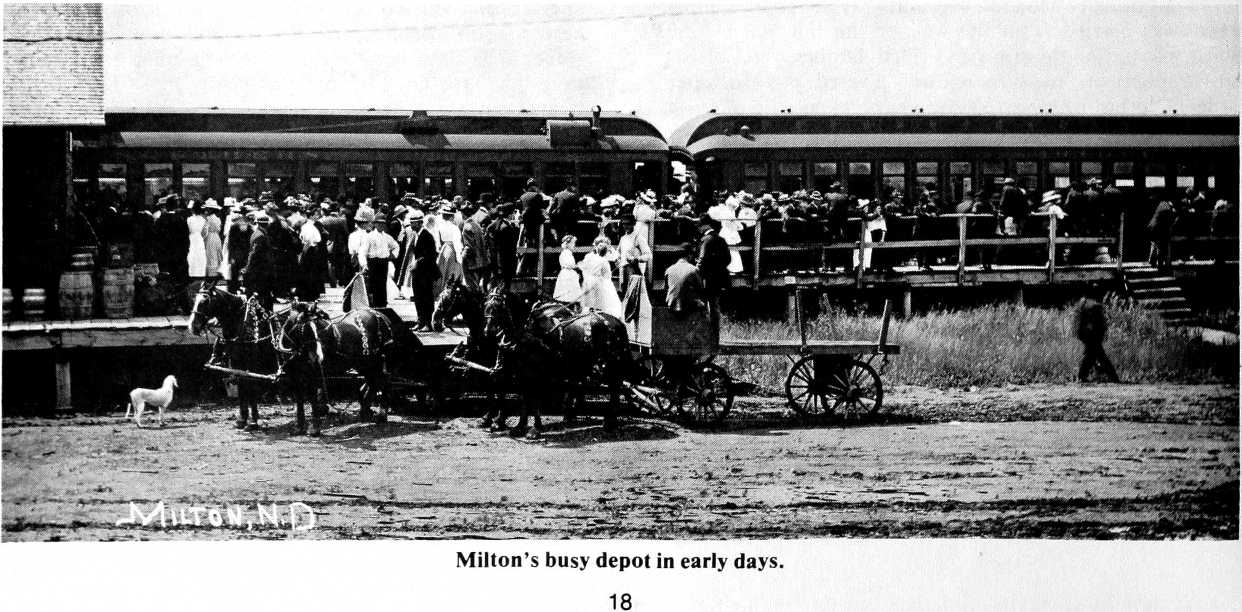
Sometimes referred to as "The Manitoba Line," in the early days, the railroad immediately became the "lifeline" of the pioneering days. All the supplies needed for building, farming and essential living arrived by train. The depots and unloading platforms were quickly built and the two passenger trains that passed through Milton daily, provided transportation for travelers. Before the days of autos and good roads, everyone traveled by train and the trains were crowded. Salesmen traveled by train and often stayed over night in the local hotels.
For many years, a "section crew" was based at Milton and the crew foreman and his family lived in the house owned by the railroad. It was located approximately where Robert Hunter’s shop now stands. It was the duty of the section crew to patrol the stretch of railroad assigned to them daily and make repairs. Although they first traveled up and down the tracks on a small open car that was "pumped" by hand, these cars were later equipped with gas engines. Often referred to as "the Speeder," these open vehicles offered little protection for the crew on their daily patrols during the cold winters. These vehicles were often used in emergencies to haul mail and supplies when spring floods or storms disrupted regular train service, such as the spring of 1950, when a washed-out bridge near Park River kept the regular train from coming to Milton and west for many days.
The headquarters for the section crew was eventually moved to Osnabrock and today the railroad is patrolled by a crew riding in a pickup driven on the rails.
In the mid-1930s the steam locomotive that pulled the passenger train was replaced with a diesel engine. It was the end of a colorful era. Now it was not possible to look to the east or the west for the smoke from the steam locomotive which once indicated that the train was at Union or Osnabrock. Gone too was the hiss of steam as the train stopped at the depot and gone too was the chance of getting cinders in your eyes if you were riding the train and had a window open.
The diesel engine which was promptly nicknamed the "galloping Goose," was used until the last passenger train made its run through Milton on October 31,1959.
The construction of excelled paved highways and the advent of fast comfortable cars and large semi-trucks brought about the end of passenger rail service to our town, as well as the delivery of mail and express by rail.
The younger generations will never know the excitement of being at the depot in the late afternoon as the eastbound train arrives and seeing the depot filled with people about to leave on a trip, along with those "seeing them off." They will never see the depot agent pull the small four-wheeled wagon to the "express and mail car," where the out-going mail and express was loaded on the car. They will also never see the conductor waive to the engineer that departure time has come or hear the "toot- toot" of the steam whistle as the engineer acknowledges that signal. They will never hear the hiss of steam, the clanging bell or the first "chuff" of the engine as the engineer opens the throttle and the train speeds off to the east. Then, as it becomes quiet at the depot, the publisher of the Milton Globe trudges back to his office to record in next week’s Globe the names of those who arrived or departed on the train.
While some rural rail lines are now abandoned, Milton is fortunate that freight service is still provided. Although our depot and loading platform are gone and one can no longer take a trip on the passenger train from Milton, the "Burlington Northern," as it is known today, is still moving much of our grain to market.
The wood trestle west of Union was earth-filled many years ago and 1983 will see Burlington Northern renovate and improve their track through our area during the summer months.
The community owes a lot to James J. Hill and the others associated with the Great Northern Railway, who provided the rail facilities which played such an important part in the pioneering and development of the Milton area.
Written by Charles Stabo
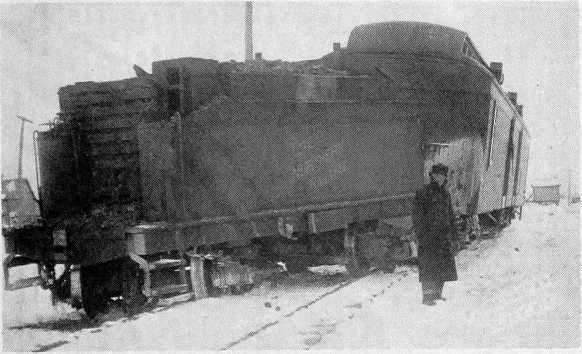
Train derailment at Milton.
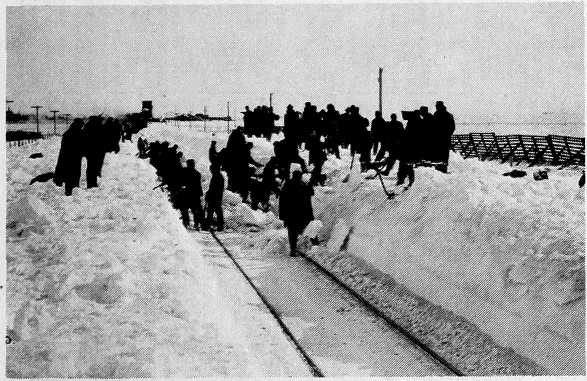
"Clearing the tracks near Milton," about 1906.
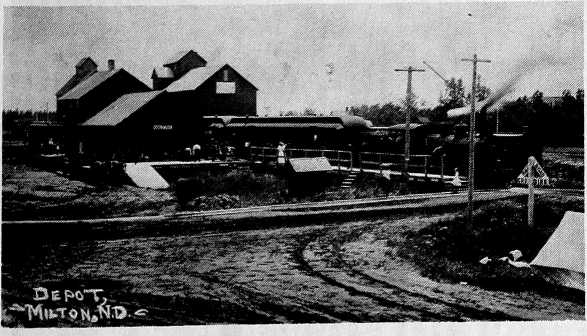
Taken about 1910.
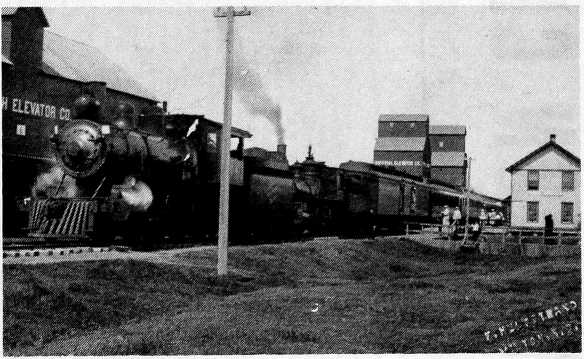
Milton depot scene, about 1913.
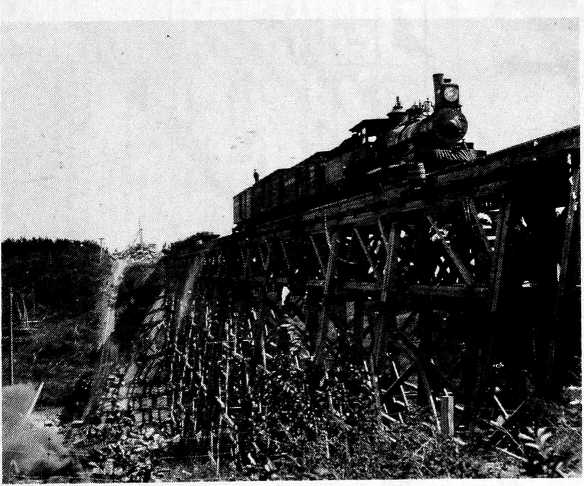
Railroad Trestle northwest of Union.

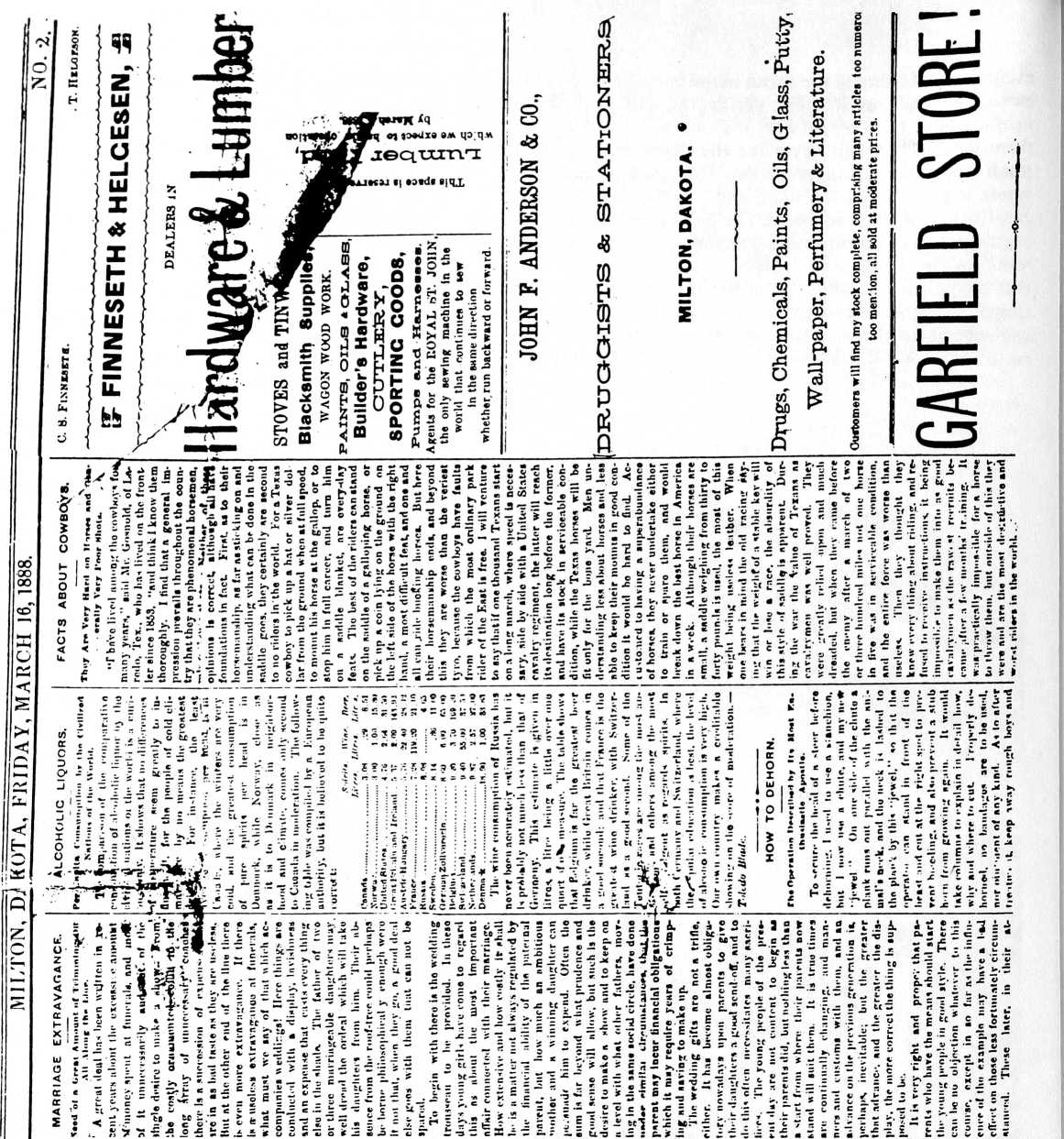
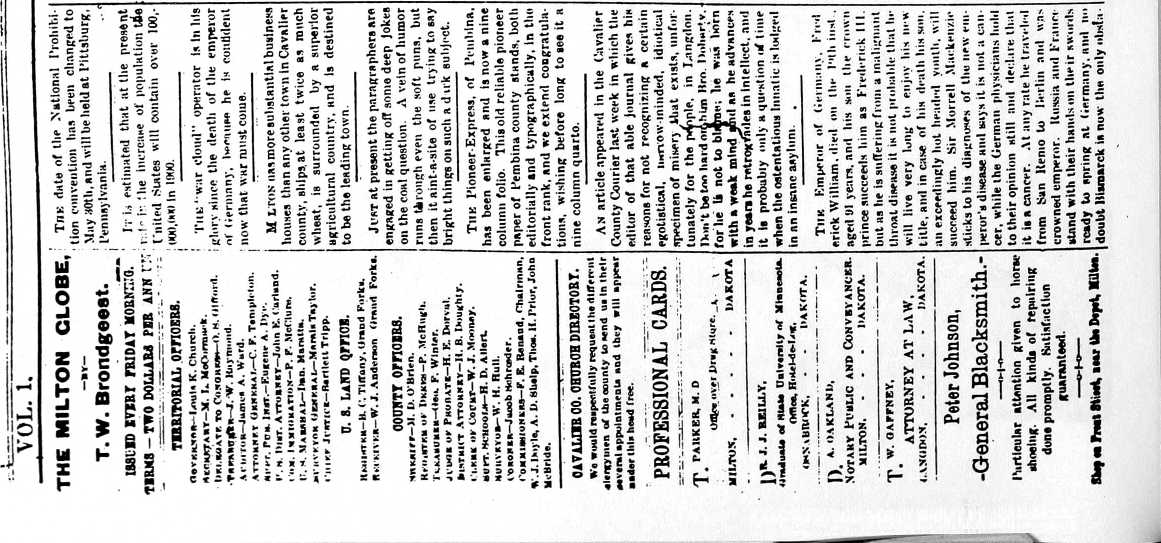

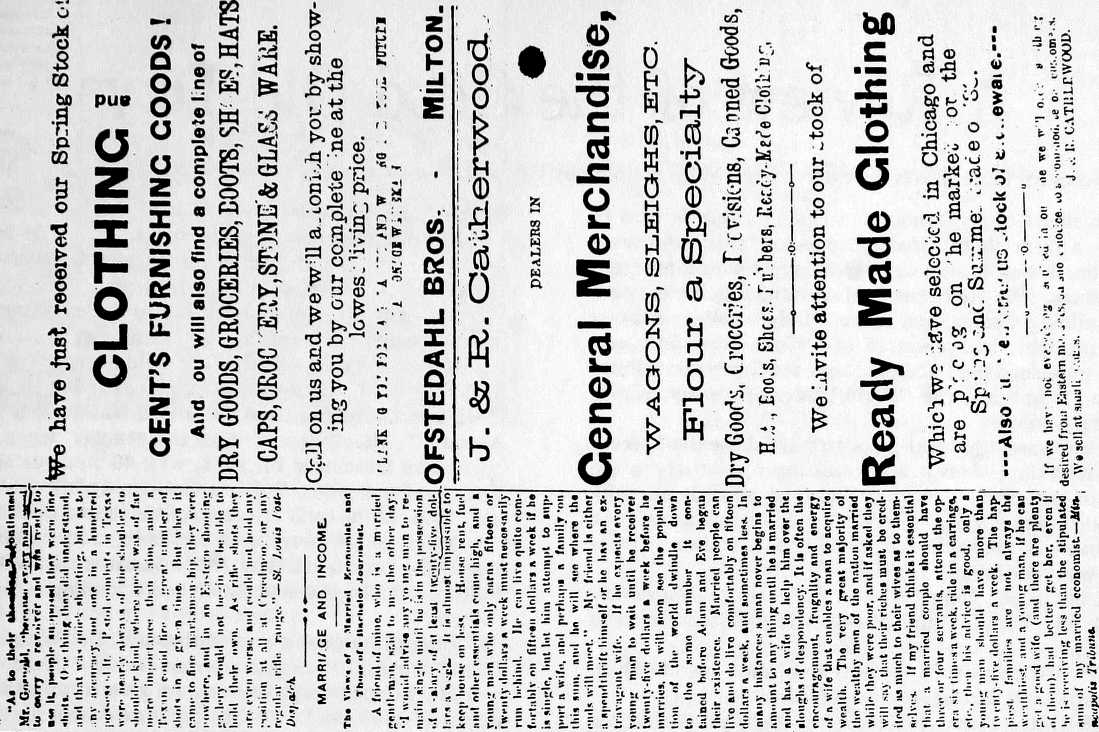
Notes for these stories were taken from Milton Globes by Historical Committee. Articles written by Charles Stabo.
Cavalier County’s first newspaper was established in 1883 on a farm about three and one-half miles southwest of Milton. The publisher was Jacob Hager who came from St. Thomas, ND. He brought his printing equipment to a small building located on a corner of Henry Watson’s tree claim, probably in Section 15 of Osford Township, and here he published the "Dakota Sun" for four years. Henry Watson’s home was the "Elgin" post office and Henry was the postmaster.
There was little local news to publish in the Dakota Sun, but in those days it was necessary for settlers to file proof of settlement on their land in accordance with government regulations. This was called "proving up" and since that was the settlement period, publication of these proofs was profitable.
In later years, Henry Watson’s son, Harry, bought the Dakota Sun building and attached it to his house as a bedroom.
The first Milton Globe was published on March 9, 1888, with T. W. Brondgeest as publisher.
The Milton Area Historical Committee has searched through every Milton Globe that was published, for items of interest, and we present them in this section for your enjoyment. The pioneers are all gone and with them the first-hand knowledge of the early days, consequently, we are grateful for the history that was preserved in the Globe, the Cavalier County Republican and other publications.
Before the days of established townsites, railroads and rural mail delivery, many post offices were established in the homes of pioneers. In some cases, supplies were also sold at these places. The pioneers could travel to these post offices and get their mail which arrived two or three times a week. In addition to Elgin, there was Alma, at the John McBride home in the northeast corner of Section 16 of East Alma Township. Romfo is said to have been in the southeast corner of Section 14 in Alma Township and Young was south and east of the village of Concrete. Strate was located in Section 25 of Osford and Gertrude was not far away in Section 27 of Osford. In addition, there was Irene, Kinloss, Carlisle, Merl, Mountain and McLean. These names headed columns of news from those areas in the Milton Globe for many years, and later, news columns were headed, "Union Units, Soper Siftings, Mountain Musings and Osnabrock Globules." With the 1905 census showing Milton’s population at 500 and Montrose Township with 812 people, there was lots of news. Subscription rates for the Globe in 1903 was $1.50 per year — quite a bargain! Perhaps it was not enough, for in 1933 during the Depression, the paper carried this notice, "If you would like to renew your subscription, we will accept wood, vegetables, poultry, preserves, potatoes, good butter or anything a hungry printer can eat or burn."
When the railroad which was often referred to as the "Manitoba Road," reached the Milton townsite in 1887, the area boomed. All the land was quickly taken and the 1888 Globe reported that 150 buildings were built the first year. The residents pointed out with pride that Milton was the first town west of Grand Forks on the "Manitoba Road" to have a brass band and an Opera House.
Milton celebrated the 4th of July in 1888 with the local trombone band leading the parade, baseball games, horse races, a bowery dance and fireworks.
By 1889, the community had donated $100 to buy white caps and capes for the band members.
Milton Tressing was the first child born in Milton who lived. By 1888, there were 57 children living on a three- block stretch on Poplar Ave., and it was known as "Kid Avenue." Mr. Falconer was the teacher when school opened on December 14, 1888, with 40 students enrolled. Mrs. Joseph Powles, William Graham and S. A. Wroolie were some of the early directors of the school district.
More people were arriving daily, and building and improving continued. The 1888 valuation of the town of Milton was $80,000 and banks were lending money at 6 percent.
Interesting people passed through. Dr. Wheeler from Grand Forks, often mentioned in the "Jesse James" stories, stopped long enough to give a pistol-shooting demonstration, and awed the big crowd with his shooting skill.
Digging wells for a water supply was a first priority for the pioneers. While digging a well behind the Lars Wall barber shop, the worker discovered an Indian tomahawk at a depth of fifteen feet and residents pondered for days as to how it got there.
A great source of fear for everyone was the threat of prairie fires, as most of the land had not yet been broken. There was little snow the winter of 1888-89 and toward spring the glow of fires on the horizon at night put fear in the hearts of the people. One day in April, a strong south wind swept a large fire toward Milton. It had destroyed all the buildings on the Stengrim Nelson farm south of town, as well as some other buildings in the country and it took an immense effort on the part of all able-bodied citizens of Milton to stop the fire just short of the new elevator. Later in the day, as the wind swung toward the west, it was necessary for the people to turn out again and help save some rural homes as well as to stop the fire at the west edge of Milton. Fearing more problems to the north, the people picked a calm evening and back-fired north of town, thus stopping the threat.
Conveniences were' few. By 1888, several homes in Milton were connected by telegraph wires, making communication between those homes possible. It was not until 1903 that a telephone exchange was installed in the rear of the Close drug store and 50 people immediately signed for phones. Rural telephone lines came even later.
The people wasted no time in establishing religion in the community. The Methodist church was completed and on January 1, 1889, it was dedicated. Providing music was an instrumental group consisting of E. O. Holler, first violin; Nils Koppang, second violin; Adolph Anderson, cello; John McCarthy, cornet; and Joseph Powles at the organ.
Father Ricklin conducted the first mass in Milton at the Northwestern Hotel in March 1889, and by May, the Catholic people had purchased lots for a new church north of the Methodist church.
J. Peterson and W. Raymond had completed the Presbyterian church and it had been papered by McCarthy Bros., so a dedication service was held in April 1889 with Rev. P. M. Wood of Fargo as speaker.
The Lutheran congregation was organizing in Milton in 1889, as well as several in the country. The West Mountain Lutheran Church was dedicated on July 9, 1902, with Prof. Bockman, president of Luther Seminary as the speaker.
1889 was not a good year for the farmers and by December of that year, our first governor, Mr. Miller, and other state officials launched a program of distributing food, feed and other assistance to rural people, especially in the central and western parts of the state.
In spite of this, business was booming in Milton. Towns such as Adams, Fairdale and Nekoma were not yet founded and there was no railroad to Olga, so Milton was the trade center for a large area. Huge shipments of food, clothing, lumber, machinery and other supplies were unloaded at the Milton depot and carted off to those areas, as well as what was used locally. In 1888, the Globe reported that more grain was shipped from Milton than from any other town on the "Manitoba" road west of Grand Forks.
N. E. Stevens was the depot agent in 1891 and during the month of August in 1892, the freight charges on goods arriving, plus passenger ticket sales amounted to $4,295. Income from express and telegrams that month was $245 and freight charges on out-going shipments to be collected at their destination amounted to $5,000.
Also in 1892, the Milton Post Office was made a "money-order" post office and people came from as far away as Langdon to purchase money orders. Two passenger trains passed through daily, No.’s 81 and 82.
In 1891, the Milton Globe was an offical county newspaper and the people offered to furnish the site and $7,500 to build a county courthouse if Milton would be chosen the county seat.
To make things nicer for the many visitors, a lumber sidewalk was constructed from the depot to the Northwestern Hotel and petitions were circulating for more such sidewalks.
Although there seemed to be great emphasis placed on moral values, as evidenced by the early establishment of churches and cultural activities, the community had its share of wayward people, thefts, vandalism, arson, murders and other crimes.
The Milton Area Historical Committee has decided not to include the lengthy accounts which were printed in the Milton Globes concerning the murder and abortion trials which pertained to this community.
The Globe did express the indignation of the majority over the fact that some people living to the northwest insisted on working on Sunday regardless of the time of year. Those people were reminded that it was not only against the law, but also offensive to their Christian neighbors and they had better stop to avoid serious confrontation! The people were also opposed to and would not tolerate Sunday baseball.
In 1893, Tom Florence was held up near Milton but pulled his pistol and shot at the robbers. He thought he hit one but they got away. A few years later, some "lumberjacks" tried to rob Hans Overboe while he was delivering mail but he put the whip to his horses and managed to get away.
Horse thieves prowled the country too, and several farmers lost horses. One thief named McDonald sold a team to Joseph Slama but when it was discovered that they were stolen, he was caught at Grand Forks and shipped back to Canada to stand trial.
There was a rash of fires around 1915 and most of them involved property owned by C. W. Plain. Arson was suspected, and in 1916, a man named Rutz was caught in the act as he set fire to one of Mr. Plain’s houses located south of the Northwestern Hotel. He was caught, arrested, tried and sentenced to six months in jail.
Prohibition was in effect in early days but there were those who had "stills" and produced and sold the brew to those who wanted it. Usually located in the back rooms of a building, the illegal "pubs" were called "blind pigs," and the operators were known as "piggers." Then there were the "spotters" who "squealed" and told the sheriff and on November 1, 1895, Sheriff John McGauvran and Deputy Dawson raided some of Milton’s blind pigs and arrested the "piggers." A quantity of brew was confiscated. Transient harvest hands had a "booze party" one night at the Sever Anderson farm, and eventually a fight broke out among them and one man was stabbed.
So what was life like "way back" without electricity, radios, TV, luxury cars and jet-age travel? It is obvious that the people enjoyed themselves in many ways.
They lost no time in organizing several lodges including the I.O.O.F., Masonic, K.P., Yeomen, Foresters, Woodmen, Workmen, Orangemen, Eastern Star, Royal Neighbors, Rebeccas, Degree of Honor, Knights of Macabee and others.
And then there was the opera house. Located upstairs in Plain’s Hall, it was always the scene of activity. Traveling performers appeared regularly. To mention a few, there was "The Tennessee Minstrels," "Bob and Eva McGinley" and many others. In 1915, "That Printer of Udells" was playing. The opera house was also the scene of many local activities such as the "Hot Fowl" supper, complete with all the "trimmings," which was served in 1910. It was followed by a literary and musical program and the admission for supper and program was 35 cents. Back in 1903, the Lutheran Ladies Aid served a supper at Plain’s Hall and in March of the same year, the opera house was the scene of an "Old Maid’s Convention" for the purpose of raising money for a new piano for the school. James Foley was at the opera house in 1911.
The firemen always had a "Firemen’s Ball" each year and in addition, there were many other dances throughout the year. Many of the local people made it a point to attend dances in neighboring towns and the neighbors came back to local dances as noted by the Globe in 1919, when the “Union Units" column reported that Alvina Nelson, Nettie Skare, Martin Anderson and William Gutterud attended the Milton firemen’s dance.
There was always enough local talent to provide music for dancing. "Delling and Cain" played for a dance in 1889. Another group who played was known as the "Blue Jackets" and a concert group was the "Bon Ton Orchestra." A 1923 concert played by the "Bon Ton" included Miss Gislason, Rev. Herleikson, Mr. Sehrt, Mr. Foseide, Grant Swanlaw, Millard Flom, Victor Ofstedahl, Tommy Flom, Mr. Eid, Mr. and Mrs. R. Waite, Alfred Asgrimson and Bruce Laing, with Adolph Anderson as director.
1914 saw Milton hosting a "Norsemen’s Celebration" in January with Governor Hanna as the speaker. C. W. Plain donated the opera house and his furniture store for dances and in spite of a storm, there was a good crowd.
The earlier days saw people inviting friends to their homes for whist and dancing parties much oftener than today and during the winter months, the Globe reported such gatherings in every issue.
Evenings could also be spent at the "Electric Theatre," which in later years became the "Star Theatre." Until about 1930, the movies were the "silent" type and music was usually provided by a pianist. Minnie Welo, at one time, was the pianist and later a "player piano" was used.
Other winter pastimes included skiing and sliding in the coulees near town and the town usually had a skating rink. In February of 1892, a grand "Masked Skating Carnival" was held at the rink. Music was furnished by the Milton Trombone Band and no one was allowed on the ice without a mask until 9 p.m. and which time all removed their masks.
New Year’s Day of 1904 was unique for North Dakota, with warm, balmy temperatures, and Milton celebrated. The Milton band, all dressed up in new white hats and dusters, played a concert in the streets and the
Milton baseball team played the "Maroons." A horse race followed between C. Olson’s "Billy" and Ole Huset’s "Never-Say-Die." This was followed by a football game but the play was listless due to the warm weather and people spent a lot of time at the lemonade and ice cream stand.
Milton also had billiard parlors and a bowling alley which provided an outlet for leisure hours.
The "cost of living" was a bit different "back then," too. In 1903, Leaf and Brothen Store ran the following ad in the Globe. "One lb. coffee, 10 cents; lb. tea, 28 cents; lb. apricots, 8 cents; lb. prunes, 4 cents; lb. raisins, 9 cents; can peaches, 16 cents; 8 bars of soap, 25 cents. Men’s suits sold from $5 to $13 and $5 bought a boys’ overcoat.
In 1905, Johnson & Wroolie Store sold cook stoves for $28.50 and sewing machines for $14.50. The same year, the editor of the Globe suggested that some new small homes that would rent for ten or fifteen dollars a month would be a "good investment."
In 1911, Halliday’s Store advertised ladies’ "strap pump shoes" for $1.69 and ladies’ "rust-proof" corsets for 98 cents. Phonographs sold as low as $15.
Hunting was another pastime which sometimes proved to be profitable. In 1888, John E. Thompson marketed 50 fox pelts. Wild game, including fox, coyotes, wolves, bear, bobcats, deer, elk, prairie chickens, grouse, ducks and geese were prevalent and there were also some antelope. Wolves were described as "on the increase and getting bold" in 1889, and in 1904, John Gillespie trapped seven of them north of Milton. Ole Laird shot a black bear in 1889 and George Hjelmstad shot a large black bear in 1906. A farmer near "Gertrude" sneaked up on a sleeping antelope while out in his hay field and caught it. While cutting wood on a cold, winter day near the Swanson farm in East Alma, about 1889, Ole Stabo hung his brand new winter overcoat with his noon meal stuffed into a pocket on a low tree. When mealtime arrived, he found that a bobcat had shredded the coat and had eaten his noon lunch.
Large groups of men often spent winter Sunday afternoons hunting jack rabbits during the ’30s and early ’40s.
In 1915, a young deer began appearing in C. W. Plain’s yard and was also seen with his cattle. Someone could not resist the temptation to take a shot and wounded it and although Mr. Plain called Dr. Elliott, the veterinarian, to treat the animal, it died. Mr. Plain had the head mounted and it is now at the Charles Stabo home.
Gophers were a severe problem in the early years and large hunts were organized. Two "teams" were selected and the team that brought in the most "tails" were treated by the losers. Treating the losers was really not expensive as a Sunday dinner at the Northwestern Hotel in 1894 cost 25 cents.
Summer months were filled with picnics, baseball, and sometimes an excursion to a lake. "Lykken’s Lake" was a popular place for a picnic and in 1913, A. E. Welo built a boat that was powered with a gas engine driving paddlewheels and he then took the picnickers for rides on "Lykken’s Lake." Martin Johnson had a "Model T Taxi" and when bringing a group back to Milton from an outing at the lake in 1914, it became dark and he ran into a team driven by Ed Slama. Fortunately, no one was badly hurt.
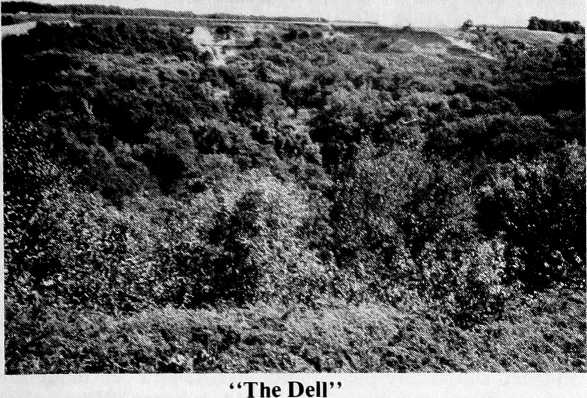
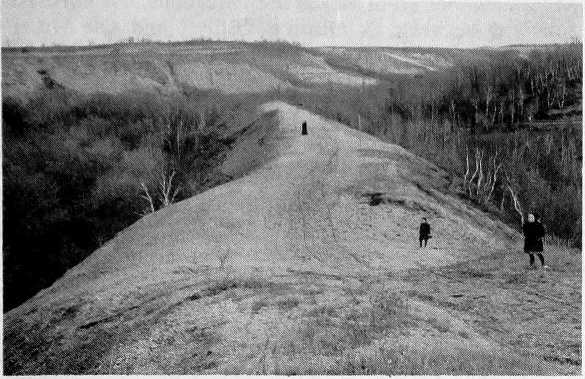
"The Dell" located in the coulee just east of Milton and near the farm home, formerly owned by Bob Goodbody, and in later years by the McLaurin family, was the favorite picnic spot. School children from Milton and from many neighboring communities enjoyed year-end school picnics here; and there will be many who will remember climbing the shale banks. Picnics were also held near the "hogsbacks," one near town and another about one and one-half miles east of town. These are high, narrow, shale formations, the result of erosion down through the ages, which extend into the coulees.
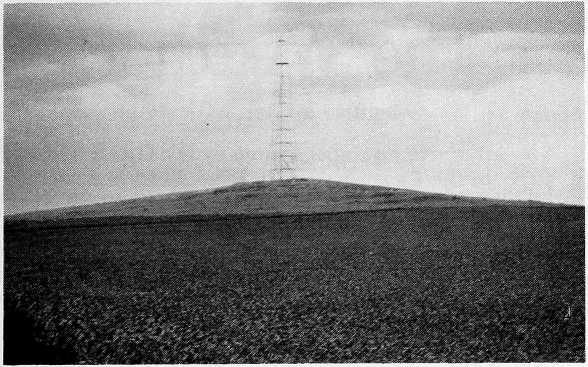
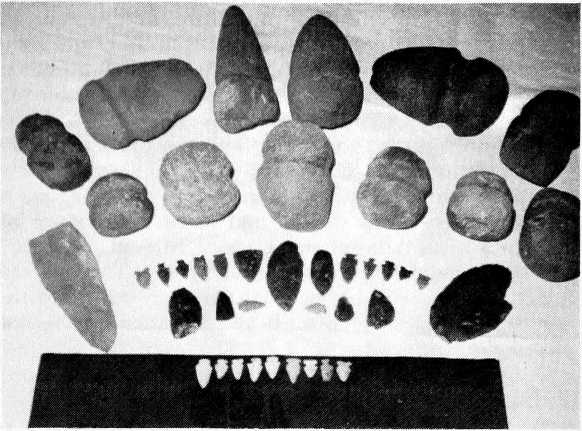
Another point of interest in the community is the high hill located about three-quarter of a mile east of Milton. It has been known down through the years as "The Indian Hill," "Plain’s Hill" or the "Big Hill" and most young boys and a few girls have climbed to the top during their younger years. Some think it may have been an Indian burial ground and H. R. McLaurin did indeed find a skull there in early days. There are definite signs of Indian encampments near the hill in early days as evidenced by the collection of Indian artifacts found near the hill by Charles Stabo. A fifty-foot tower was temporarily erected on the hill in 1968 for use by the Coast Guard and Geodetic survey crew and it has also been a "point of beginning" for other governmental survey crews.
From pioneer days to the present, people have found a way to travel. The mode of travel progressed from the days of the oxen, to horses, bicycles, trains and automobiles. In 1905, John McCarthy bought a new eight horse-power Cadillac and brought it to Milton. It was not long until cars became numerous. Nine thousand cars were licensed in North Dakota in 1913 and there were many models to choose from. The Globe carried ads for Ford, Chevrolet, Cartercar, Buick, Dodge, Hupmobile, Wilcox, Jackson, Pullman, Graham-Paige, Flanders, Regal, Studebaker, Essex, St. Louis, Metz, Brisco, Reo, Star, Mitchell, Crow- Elkhart, Overland, Roosevelt, Whippet, and Wyllis, to mention a few. In 1920, gas sold for 30 cents per gallon.
Runaway horses was a frequent occurance and made a good excuse to go and buy an auto but some of them "got away," too. Better roads for the autos were needed and people dragged the roads and Milton’s streets with what they called "splitlog" drags. Milton’s speed limit in 1915 was twelve miles per hour, and when Anton Bakken was caught speeding and fined $5.00, he paid the fine with a smile, stating that he was glad his car had so much pep!
In 1913, Marvin Green was selling Indian motorcycles for $200 F.O.B. When Joe Axvig hit a rough spot in the road near the Plain farm with his and "took a spill," he promptly purchased a side-car.
Most long trips were made by train but there were times during the winter when even the trains became snowbound.
On April 7, 1904, the passenger train became stuck in a deep cut east of Milton. They finally got out but struck another big drift east of Osnabrock and one car was derailed. The same evening, the freight train also got stuck east of Milton. The engineer and fireman unhooked the engine from the train and managed to get about a mile before getting stuck again. They had to let the fire die in the fire box and since it was very cold, they survived the cold night by crawling into the fire box after it had cooled off sufficiently.
The local people had a keen interest in politics and several served as legislators. Then, as now, they were not always happy with the government and in 1913, the Globe reported that the people were afraid the government would "wreck the country."
In 1910, 75 gypsies came to Milton but since no one wanted their "fortune told," they were asked to move on.
The Globe carried many ads for remedies and medicines that would "keep you well." One early day ad stated, "If you can’t eat, sleep, work, feel mean, cross and ugly, drink Hollister’s Rocky Mountain tea." Other "over-counter" remedies included Peruna, Lydia Pinkhams pills, Dr. Green’s Nearuvra for blood and nerve remedy, St. Jacob’s Oil for rheumatism, Dr. Bull’s cough syrup, Morrow’s Kid-Ne-oids for sick kidneys, Sloan’s liniment, Carter’s little liver pills and Bell-Ans for indigestion. Yes, and you could "kill that cold" with Hill’s Cascara Quinine.
While you recuperated from any of the above problems, you could stay in and listen to a choice of "Atwater-Kent, Arborphone, Crosley, Majestic or Ajax" radios, depending on which one you bought. They worked pretty good provided your arial wire was strung to the nearest building and the A, B and C batteries were not played out.
Sixty or seventy years ago, according to those who remember, everyone in the Milton area flocked to the "big tent" that was set up where the new Milton school gym now stands to attend "The Chautauqua," usually in midsummer.
The dictionary describes "Chautauqua" as a "summer school" and it originated at Chautauqua, NY, in 1874. It consisted of lectures and concerts and was meant to be educational and recreational.
Although Milton area people quite often traveled to Devils Lake on "special trains" that the railroad company ran to accommodate the crowds that wanted to go there for the "Chautauqua," Milton also had its own Chautauqua for many years.
The June 14, 1917, issue of the Milton Globe described some of the performances of the Milton Chautauqua which had just ended. The Friday night entertainment consisted of the Tyrolean Yodlers and their rendition of the "echo song" was superb. On Saturday night, Dr. F. E. Hopkins delivered his lecture on the "Golden Fleece," using Jason’s determination as good advice to young people just starting out in life. On Sunday night, the Shawmut Male Quartet performed and Monday night’s program included the "Merry Musical Maids," and a lecture by Albert L. Blair, an editor and newspaper man with 30 years experience. The Fairchild Sisters Orchestra performed Tuesday night as the closing number of the session and the Globe maintained that the Milton Chautauqua had been very successful, both financially as well as being very "high class" entertainment.
The following article about the Devils Lake Chautauqua is contributed by Myrtle Gjevre.
William Jennings Bryan was the speaker at the North Dakota Chautauqua at Devils Lake, ND, back in 1905. A special train on the Great Northern Hannah line was run to Larimore and from there a very long Chautauqua Special was waiting to take people to Devils Lake. Ole Gjevre happened to be in Langdon so he got on the Hannah train. Mrs. Gjevre, son Edwin, daughter Ingeborg, and niece Ida Bakken, and Nick and Olive Nelson who were staying at Gjevres, were among the number who got up in the middle of the night and drove by team to Milton (a light spring wagon was used for that part of the trip), a distance of 14 miles. C. P. Helley, who got on with the folks at Milton, helped the brakeman sell apples and oranges on the Hannah line. When the train reached Larimore they changed cars and got on the Chautauqua Special which headed for Devils Lake. Small trains carried passengers back and forth between the grounds and Devils Lake. All folks bent on hearing that wonderful man, Bryan, who spoke afternoon and evening. It was said that every word he uttered could be heard as there was something that is called "quiet" that pervaded that vast crowd. After the speech, people went back to Devils Lake. Eating places, both at the Chautauqua grounds and Devils Lake, were short of food but the men in the party managed to get sandwiches and some root beer. As they left the place of purchase a train pulled out. Thinking the family was on that train, they made a dash for it. Presto. Corks popped and the liquid in the bottles squirted up on the men’s suits and hats. They made the train but no familiar faces could be seen. When they arrived in Larimore they waited until another train came bringing the rest of their company who by this time were a little on the hungry order. Needles to say, outside of hunger pains, they had enjoyed the day even if it lasted about 24 hours. They must have traveled about 150 miles. How different a trip to Devils Lake today in your car, being less than two hours. You could even take your own lunch along with vacuum bottles, so you wouldn’t be forced to starve, so to speak.
Submitted by Myrtle Gjevre
Weather reminiscences written by Ole Gjevre January 2, 1927, to the Cavalier County Republican at Langdon, ND, is as follows:
I will give a little history of January 2, 1889, thirty- eight years ago today. The second of January of that year came on Wednesday with beautiful sunshine and warm atmosphere. I drove to Milton and on my arrival at that place the band was serenading the town in their linen dusters. A lemonade stand was erected where the W. P. Wildgarage is now located and Joseph Catherwood, then a general merchant of Milton, and another man ran a foot race in their bare feet. John McCarthy, the expert photographer, was present and took different views of the band in their linen dusters, the lemonade stand and the bare foot race. A ball game was also played. On the photos appeared the date, month and the year, as well as the place where the pictures were taken, to show the rest of the world what a tropical climate we enjoyed in North Dakota at that time of the year.
On October 29, 1896, snow began to fall and it snowed every day for one month. Some days, of course, it did not snow much but for one month it never let up. During all that time there was no wind and by Thanksgiving there was three feet of loose snow on the ground. On the evening before Thanksgiving it started to blow and the wind being so strong that a man had difficulty standing on his feet and with that amount of loose snow you can very easily imagine what kind of a storm we had. That Thanksgiving will never be forgotten by the old settlers.
To describe every detail of farming and farm life since pioneer days, would require writing an entire book. This article is written only for the purpose of incorporating a few notes taken from the Milton Globes.
By Charles Stabo
When the pioneers arrived and chose a tract of land, their first and greatest concern was to build a home. A few arrived with enough lumber loaded on their wagons to build a small house but many arrived with only a few tools and had to utilize materials at hand to construct a dwelling.
Quite a few pioneers, especially those who did not live close to timber, built sod homes. The native sod was turned over with their breaking plows and layers of this sod was piled to form the walls. When the walls were high enough, supports were layed across the top and sod and dirt was placed on this to form the roof. Most had one door and the windows were few and small. While they may have held both cold and heat out quite well, the roofs leaked when it rained and it must have been frustrating for the lady of the house when it came to "house cleaning."
Other "claim shacks" were tiny frame dwellings covered with tar paper. Where timber was available, a great many built log cabins. Most of these early homes were small and in view of the fact that most couples raised large families, they built larger and better homes as soon as possible.
Many of the pioneers who built their first home from logs simply added frame additions to the log house and covered the logs by siding the outside and lining the inside. Others decided to abandon their first homes and build a new house.
F.O. Rustan, Montrose Township pioneer, decided to build a new home in 1913 and kept careful records of the entire project and the total cost.
The fall of 1913, Mr. Rustan built a large cement mixer and after digging the basement, poured the foundation, walls and floor and also laid the sub-floor. The spring of 1914, he made a contract with G. T. Olgierson, carpeter and farmer from the Gardar area to build the house. The two-story house was double-lathed so it could be back-plastered and the roof had ten "valleys" and was cedar-shingled. A 20x60 inch double-flu chimney, forty feet high was constructed for the fireplace and furnace.
Mr. Olgierson and four young men arrived at the farm on April 6, 1914, and pitched a tent for sleeping quarters. With Mrs. Rustan furnishing their meals, they began to hammer and saw. Hoists for raising bricks and mortar and power saws and drills did not exist, so it was all done "the hard way." The house was completely finished on June 1, 1914, and the Rustan family moved in the next day. According to the records kept by Mr. Rustan, these carpenters worked for about $ 1.50 per day.
The total cost of the house was as follows: C. W. Plain, lumber for house, $2,410; Mr. Olgierson, labor for building house, $875; cost of chimney, screened-in porch, and sidewalks, $400; hot water furnace, $375; and cost of basement, $275. Other costs were hardware, $130; paint, $50; fireplace, $40; painter, $85; screens and labor, $38.50; woodwork in den, $30; cement patches, $50; and blinds for windows, $22.
It adds up to $4,780.50 and the fitting and craftsmanship are equal to or superior to what is done with modern tools. Mr.and Mrs. Orville Rustan presently live in this house.
While almost every original rural home was replaced at some time, the Globe did not report every building project. They did report in May of 1910, that Herman Koppang had started building a new farm home for C. W. Plain and three years later, John Throndset shipped two car-loads of building blocks to Milton for his new home in Montrose Township. May and June of 1915, found Dr. Elliott building a new home in Milton and Kristine Goodman building a new home in East Alma. A bond election was also held in Montrose Township in 1915 to decide if they should build three new schoolhouses.
The pioneers did more visiting and were always closer to one another, and perhaps more willing to share than one finds today. It was the accepted way to be able to borrow the neighbors walking plow, wagon, horses, and also kerosene, flour, sugar, etc. They also got together on building projects.
After building a 84x36 foot bank-barn in 1897, C. W. Plain decided to build a 32x60 foot barn in 1892 and 60 neighbors showed up to help "frame-up" the barn. When the barn was finished, Mr. Plain called all the neighbors over for a grand barn dance. He built another 80 foot barn in 1910.
John Wild completed a large new barn in 1897 and 18 years later, when he completed a modern two-story hog barn, he also sponsored a barn dance in the upstairs of the barn.
Joseph Slama built a new barn in 1897 and John Slama found he had a lot of good friends in 1912, when a large group of Milton businessmen came out and helped him build a new barn to replace the one he lost by fire. Angus McKay not only lost his barn to fire in 1912 but also lost 10 horses, some cattle, harness, feed and two wagons.
A. K. Johnson built one of the largest barns in the area in 1912 and Alex McKay built a new barn on the Ole Thoreson farm in 1913. Jim Brown and Peter Matheson built new barns in 1915.
Once the pioneers had a home built, they turned to breaking the virgin sod and planting crops. Wheat, barley, oats and flax were the main cash crops and most farmers had some cattle and a few had sheep.
In 1886, most of the seed wheat available had frost damage but it grew well and most were pleased with their crop. In 1889, Jack McGill seeded a lot of his crop on March 5 and 6, and he probably seeded "Scotch Fife" hard wheat. A few years later, Marquis and Kubanka were popular seed varieties. In 1892, Wm. Watson sold a load of "Beauty of Hebron" potatoes to the Pacific Hotel for 40 cents per bushel. He had harvested 300 bushels from one acre.
Wheat yields varied greatly through the early years. In 1889, farmers near Elgin reported five bushel wheat yields, while in 1895, the Globe reported that most farmers were expecting to have yields of from 40 to 50 bushels per acre. In 1900, the average wheat yield in America was 12.9 bushels per acre and it appears that most of the early day farmers were pleased if they got a 20 bushel crop. The Milton elevators shipped 214 carloads of grain in 1911.
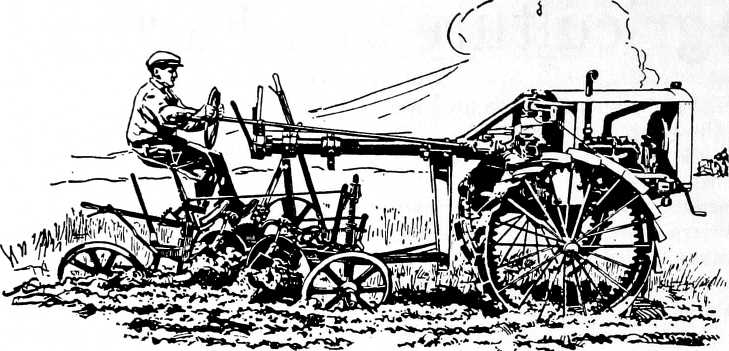
In 1891, there were five grain elevators in Milton, plus the new flour mill, so the farmers had quite a choice as to where they wanted to market their grain.
Charles Eaton and G. E. Towle built the Milton Roller Mill in 1889. Eaton later became sole owner. The mill started grinding wheat and producing "Polar Star" flour on December 2, 1889. There was storage for 4,000 bushels of grain and they could produce from 75 to 150 barrels of flour per day. A stone "engine house" housed the 50 horse-power boiler and 260 R.P.M. Buckeye engine which powered the cleaner, scourer, scalper, grader, rollers and packer. Frank Delling was the head engineer and C. S. White was the miller, with W. A. Castle as his assistant.
The legs in those early elevators were usually powered by horses, but in 1893, the Brooks elevator at Milton turned to a gas engine for power and elevator officials from miles around came to view this improvement.
In 1892, people were starving in Russia and the Milton community donated a carload of flour (14,000 lbs.) to be sent to Russia.
Ownership of the Milton Roller Mills changed several times and in 1900, G. S. Ritchey was the miller and the cost of "grinding" was 15 cents per bushel. At one time, the flour produced was known as "Milton’s Best."
As "mother nature" intermittently pleased and also disappointed the farmers, the price of land rose and fell. In 1903, you could buy good land for $2.50 per acre and by 1910, land was being advertised at about $30. Going even higher during World War I days, it dropped by the 1930s to as low as $2.50. In 1900, one area farmer harvested 2,500 bushels of flax from 100 acres, on a farm for which he had paid $750 and sold the flax for $1.75 per bushel. Records show wheat prices ranging from a low of 25 cents to a high of 92 cents from very early days up to 1912. Barley was from 31 cent to 85 cents, oats from 24 cents to 45 cents and flax was $1.84 in 1912.
In 1919, wheat was $2.07, flax $3.36 and barley 72 cents. Milton markets in 1925, showed wheat at $1.51, barley 72 cents and flax at $2.77.
November of 1931 found wheat as low as 29 cents, with barley at 14 cents, oats 6 cents and flax was 86 cents. Wheat yields in 1933 ranged from 2 to 15 bushel per acre and wheat sold for 41 cents.
In 1895, hay was selling at Milton for $7.50 per ton but cows sold for 2 cents per pound. The same year, hundred-weight prices for steers was $3.15, hogs were $4.50 and lambs were about $3.50 per hundred-weight.
In 1911, the Milton Creamery was paying 20 cents per pound for butterfat and they were also making and selling a lot of ice cream in the area. 1933 saw the price of cream at 15 cents per pound and eggs sold for 6 cents per dozen.
There was more wool shipped from Milton in 1891 than from any other point in North Dakota. It is very possible that much of this wool came from areas quite a distance from Milton.
It seemed that everyone had some cattle but some specialized in building herds of purebred cattle and many such farmers showed their cattle at local fairs and also took them to larger fairs. John Wild and C. W. Plain both showed cattle at the St. Louis Exposition in 1902 and John Wild sold a bull at the Chicago Fair in 1917 for $1,000.
The pioneer farmers had to be sure they plowed firebreaks around their crops to protect them from prairie fires and they also had a severe problem with gophers eating their crops. Community gopher hunts were organized and they made some fun out of it by having two "sides," with the losers having to treat the winners.
The incidence of frost causing damage to grain crops seemed to be greater in the early days and in 1915, there was a lot of frost damage in the Milton area, while farmers living further east at the edge of the hills, had a very good crop.
1890 saw the first wild oats appearing in the Milton area and the farmers were very angry. Wild oats had come into the area in seed oats that were shipped in. About the same time, other weeds were beginning to be a nuisance. The supervisors of Montrose Township published a notice in the Milton Globe in 1889, stating that the farmers would have to pull all mustard, Canadian thistle, French weed, cocklebur and other noxious weeds from their fields before they went to seed or they would be prosecuted.
To add to the problems already mentioned, rats began to appear in this area about 1905. It is believed the first rats reached here in railroad box cars.
At a meeting in Milton on February 14, 1900, speakers from U.N.D. and the Agricultural College at Fargo, spoke to area farmers about better farming methods. By 1912,
the Milton "Better Farming Organization" was holding meetings about better farming methods. The managers of the organization who had test plots that year were: John Einarson in South Olga; Charley Olson and Grimsi Goodman in East Alma; F. O. Rustan in Montrose; Benjamin Price in Osford; and Ed Berger in Alma. Perhaps as a result of such meetings, some farmers tried some new cash crops. In 1913, F. O. Rustan received $200 for the red clover which he threshed from four acres. In 1919, Grimsi Goodman threshed 10 acres of clover. Fie kept 900 lbs. for himself and sold $1,349 worth of clover seed to the Pratten Feed & Seed store.
It is interesting to note that as early as 1891, the Globe suggested that farmers should all grow some sugarbeets, as they would make good stock feed.
American agriculture is the most mechanized and scientific farming done in the entire world and the pioneers were equally receptive to new ways and better equipment.
Although much of the virgin sod was broken out with oxen and the walking breaker-plow, the farmers soon turned to horses for power and consequently, it became a profitable business to bring in large herds of horses from surrounding states to be sold to the local farmers.
Horse dealers and traders mentioned in the Milton Globe included C. A. Wright, T. W. Cox, C. A. Olson, C. W. Plain, S. A. Oakland and Luke Sweetman. No doubt, there were many others.
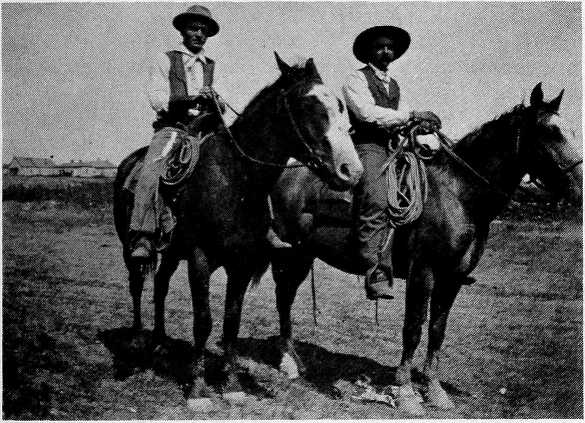
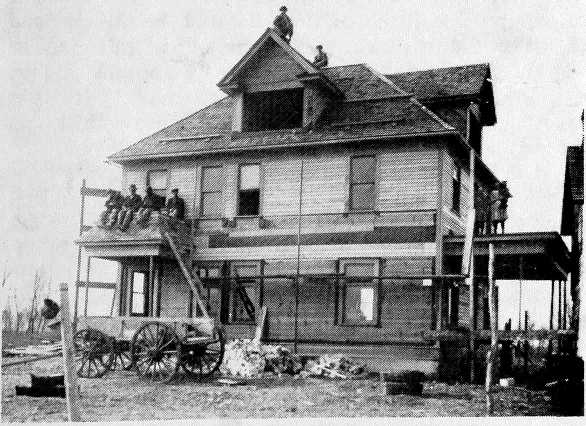
In May of 1897, S. A. Oakland drove a herd of horses from Iowa to Milton, a distance of 500 miles, in 13 days.
Early accounts describe Luke Sweetman as a colorful and typical "wild west cowboy," and the idol of many young men including Vilhjalmar Stefansson, who helped him herd horses as a young man. The Globe reported in 1899, that Sweetman and his bride received a "shower of rice" as they boarded the train at Milton to depart on their honeymoon.
A huge crowd assembled in Milton in 1910 for one of the horse sales. The top price paid for one horse was $236 and the sale grossed $3,600.
Early day equipment was manufactured by dozens of companies. Two companies making sod-breaking plows were New Deere and Prairie Breaker. As years passed, companies building plows included Defiance, Dutchman, Emerson, LaCross, Best Ever, J. Deere, P. & O., Rock Island and Oliver.
Discs were made by Massey-Harris, Canton, John Deere, Moline, Lindsay and P. & O.
It is likely that some pioneers seeded their first fields by scattering the seed by hand. The Globe reported in 1888 that W. W. Watson seeded 50 acres of wheat on April 21 from 9 a.m. to 3 p.m., using a "gatling gun" seeder. This was a broadcast type seeder which was fastened to the back end of a wagon box and driven from the wagon wheel. The seed was then "harrowed in" to the soil.
Models of early drills included Dowagiac, Fountain City, Monitor, Kentucky, Van Brunt, Farmer’s Favorite and Superior.
Owning horses did not get the work done unless you had harness for the horse. In 1920, John Norrell’s harness shop in Milton advertised harness starting at $49. Then of course, when "fly season" arrived, you needed nose-bags and fly-nets. The nose-bag also kept the horse from trying to graze while he was working.
When haying season arrived, you could buy Dain, Minnesota, Emerson, Deering, Fuller & Johnson or John Deere and McCormick mowers and rakes. The wagons used for hauling might be a Stoughton or a Rushford and Blue Ribbon buggies were popular.
When harvest season arrived, some early pioneers used Daisey reapers, and binders were made by McCormick, John Deere and Acme. The fall of 1902, the Acme Harvesting Co. demonstrated a 12-foot cut Acme binder at the R. B. Laing farm in East Alma Township and it was described as a success, but it is doubtful if anyone bought one. Most binders cut from six to eight feet, until the tractor-powered, ten-foot binders appeared. The Globe reported that Plain’s Implement sold 70 new binders in 1894.
In 1892, there were quite a few "treadmill" threshing machines in the Milton area. It required three horses to run the treadmill and the machine could thresh out from 300 to 400 bushels of grain per day when the grain was shocked. Those threshers did not have "band cutters" or straw blowers, such as later machines did and another early-day custom was to sack the grain as it came from the machine and haul it to the grainery in sacks.
Some of the companies who built steam engines and threshing machines were Buffalo-Pitts, Advance Rumley, Minneapolis, Case and there was also Reeves Steamers, Gaar-Scott and Aultman-Taylor threshers.
Small gas engines used around the farm were made by companies such as Dempster, Downs Special, Waterloo Boy and Fairbanks-Morse, to mention a few.
Another invention that appeared before 1920 was the bundle "shocker." This was a machine that was pulled alongside the binder and it gathered the bundles and made a shock of grain, tying a twine around the entire shock as it set the shock down. It did not prove to be a success.
As weeds became more and more of a problem, steps were taken to prevent the spread of weed seeds. A law was passed in the early 1900s that when a thresher finished the job at one farm, he had to carefully clean his machinery before moving to the next farm. A notice of this law had to be posted on his machine and there was a fine for failing to comply.
The Globe reported in 1893, that harvest-hands were getting hard to please, for they refused to work, EVEN for $2 per day. The thresher-man’s association fixed the harvest wages in 1911 at $2.50 per day for a field pitcher, $3 per day for a spike pitcher and $2.75 per day for teamsters. The charge for threshing that year was 10 cents per bushel for wheat, 20 cents for flax, 7 cents for barley, and 6 cents for oats.
If you needed a tent for your thresh crew to sleep in, you could buy a "thresher’s tent" at Plain & Nelson’s Implement. However, most crews slept in barns or sheds.
Many of the transient workers who came into the area in the fall to work for the large steam-thresh crews were lumberjacks from northern Minnesota. They would come with their teams and racks, and when harvesting ended, returned to the woods of northern Minnesota where they worked at logging during the winters. One such worker was returning to Minnesota one fall and on the side of his rack he had painted this message, "It’s sixty miles to water and one hundred miles to wood, to hell with North Dakota, I’m out of it for good."
As time passed, the steam-engine was replaced by smaller tractors and although the farmers were a bit reluctant to try them at first, they soon realized the tractors could do the work faster and then you did not have to feed a tractor during the winter months. Most farmers however, kept a team or two around for winter choring.
One ad in a newspaper, about 1913, claimed that the "Big Bull" tractor would replace seven horses and it sold for $650. It was a seven horse-power tractor. Another Globe advertisement was for the Samson tractor which could be bought from a dealer at Mountain, ND, for $820. The 1920 Blue Book on tractors listed the following makes of tractors: Grey, Rumley Oil Pull, Hart Parr, Waterloo Boy, Avery, Twin City, Case, Wallis, Titan, LaCrosse, Cletrac, Illinois, Little Giant, Leader, Pioneer and Russell.
Although the first tractors had angle-iron cleats on the drive-wheels, by about 1928 most tractors had what was called "spade-lugs" for traction. The Milton Globe published a notice about that time on behalf of county officials stating that those lugs were digging up the roads and it would now be unlawful to drive such tractors on public roads.
Progress continued and when an airplane flew over Milton and the countryside in 1919, everyone dashed outside to view the plane and marvel over the fact that man could fly.
Seventy years ago, most farms were not very large and consisted of from one to three quarters of land. There were a few farms which were as large or larger than the farms of today. The Milton Globe reported that John Wild at one time farmed 2,000 acres and the Goodman Brothers’ farms grew into a sizeable operation.
The largest farm in the area prior to 1920 was the C. W. Plain farm. The Globe reported in 1911 that Mr. Plain was farming 16,000 acres and he had 10,000 acres seeded to crop in 1912. His land holdings stretched from Milton to Calio, with the "home farm" located one mile southeast of Milton. Mr. Plain operated this farm until he died in 1920.
Perhaps the scope of this operation can be seen by looking at the sale bill for the first of three auction sales that were held to dispose of the property after he died.
The sale was held on July 18, 1921, and the following is a partial list of the property that was sold: one Avery steam-engine, one Gaar Scott separator, 50 horses, one Rumley tractor, one Titan tractor, one Hart Parr tractor, 11 Waterloo Boy tractors, 26 plows, 26 wagons, 11 binders, 12 disc harrows, eight horse mowers, five hay- rakes, six manure spreaders, six bobsleds, four grain drills, four bundle shockers, two Cartercars, two hay balers and a large number of items including grain cleaners, windmills and miscellaneous property. The sale grossed $13,000.
In 1928, Goodman Brothers were the first farmers to turn completely to the combine method of harvesting in this area.
Winter travel for the farmers back in the days before roads were improved and better cars came along, was a matter of being sure you had a good "road team" and either an open "cutter," enclosed "cab" or a good bobsleigh with a grain box on it and warm clothing. Some of the cabs were equipped with small stoves, windshield and even a headlight. However, the majority of the farmers simply bundled up their families in the grain box and made their trips.
There were those who tried to improve on the mode of winter travel. W. P. Wild built a propellor-driven "snowsled" in 1922 that could go 20 miles per hour. Dr. Stromberg from Langdon made a few trips into the Milton area in those days to treat sick people, traveling in a similar snowsled powered by an airplane engine.
About 1930, Carl A. Wild had a motorcycle with side car equipped with skis on the front and the side car, and chains on the drive wheel. The "tread" of this machine was about the same as the track made by a bobsled and the machine traveled well on the "sleigh roads." He later experimented with a Model A Ford equipped with skis on the front and tracks on the back.
Dr. Stromberg also made trips into the area by air. The doctor and his pilot made a trip in the open cockpit plane to the Plain farm the spring of 1928, to treat Ole Berg and in February of 1931, they flew to the W. T. Stewart farm.
What a blessing the modern "sno-cats" would have been in those days!
Although this historical book deals primarily with people, we would also like to take this means of paying tribute to the animals that played such an important part in the pioneering of this area.
Some of the pioneers arrived in wagons pulled by oxen or horses, and those who came on foot knew that until they could acquire a yoke of oxen or a team of horses, they would not be able to break the sod and plant crops. Some of the pioneers who had no oxen or horses were fortunate enough to be able to hire a neighboring settler to bring his "power" to their farm and break some of the virgin land and plant some crop. It is certain that the proceeds from the first crop was used to acquire their own oxen or horses.
Those animals meant a lot more to the pioneers than to be merely the field power. They were also the "trucks" that hauled the crops raised to market and as they plodded homeward, they pulled loads of lumber for buildings and other needed supplies. They were the "Fords and Cadillacs" that took their owners to church or to visit the neighbors, and when emergencies arose, they often made "fast trips" for help in spite of having pulled a plow all day.
Although the oxen were replaced by horses as soon as possible, they played an important part in the pioneering of this area. A few of the horses were "renegades" that were hard to handle but the majority were faithful, docile servants and a bond existed between animal and master. The farmer sheltered, fed, curried and brushed his horses, and the sickness or death of one of these faithful animals brought great sadness to the entire family.
A few of the pioneers brought a cow or two with them when they came, especially those who had lived in some other state before they came here. Those who did not, acquired milk cows, hogs, chickens and many had sheep. Since most of the land in the area had coulees, timbered land or sloughs, which could not be farmed, this land was fenced in for pasture.
Once the people had acquired all the different animals, they were very self-sufficient as far as food was concerned. They had meat, butter, cream, eggs and those who had sheep had the wool for knitting mitts, socks, sweaters, etc. The spinning-wheel was not just an antique in those early day homes — it was used.
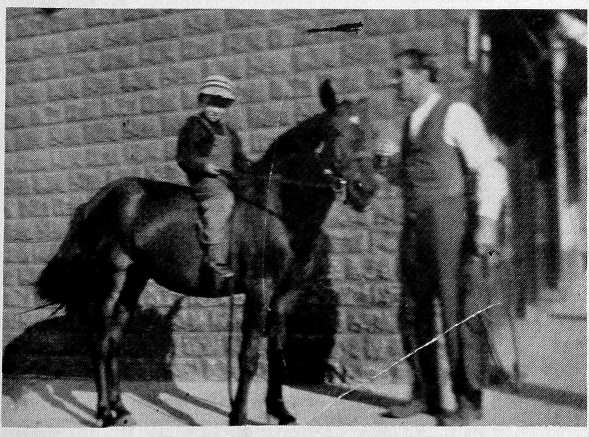
While the grain crops may have provided the largest percent of the farmer’s income through the years, the income from selling cream, butter, eggs, chickens, turkeys, ducks, geese, hogs, sheep, wool, and beef animals, was a "stabilizer" that often brought the people through years of poor crops.
Some farmers "specialized" in the livestock business by building up herds and flocks of purebred animals. To advertise the quality animals that they had, quite a few showed some of their animals at local fairs, and a few took animals to the state fair, the International Livestock Show at Chicago and the St. Louis Exposition. Not only did they sell breeding stock to people in the vicinity but some gained a reputation for having quality stock that brought buyers from other states.
Before the days of automobiles, the people who lived in the small towns usually had a barn built at the back of their lot where they kept a team of "driving horses" and many kept a milk cow and even a few chickens.
Not to be forgotten are the dogs and cats that were found on every farm. In addition to being companions and pets, many dogs were trained to herd sheep or bring the cows home at milking time. The cats served a worthy purpose by being "four-legged mouse traps."
Caring for the farm animals was a lot of work but most pioneer couples raised large families, so there was lots of help available for this work.
The trend toward small families, the decline in population in rural America and the tremendous increase in the size of farms, have all brought about an era where very few farmers have any animals. In fact many farmers now live in town and drive out to their farms to do their farming. As we look back over the past one hundred years, we should be thankful for the many animals that made it possible for our grandparents and parents to pioneer and establish this community.
Written by Charles Stabo
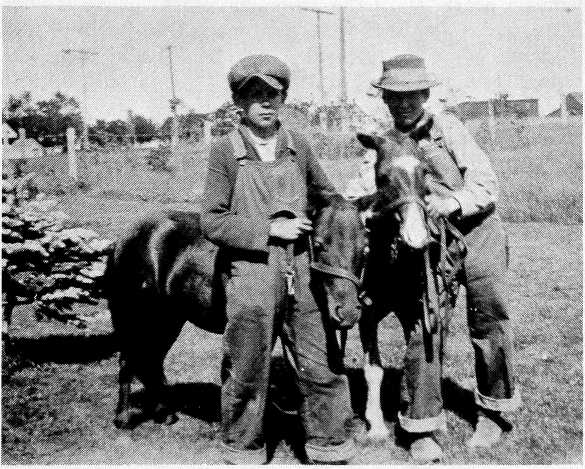
From the Milton Globe, August 22, 1912
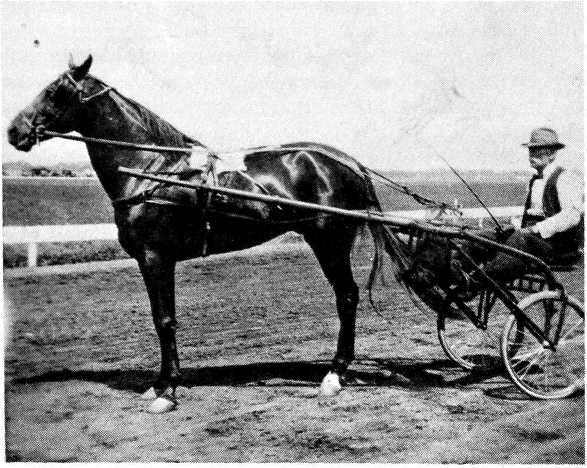
The Grand Forks Herald speaks in length of Dave Archer, the veteran horse trainer, who is training a bunch of horses at the fair grounds in Grand Forks. He has the handsome horse, Oakenheart Junior, owned by Charles Olson of Milton, in charge and the Herald says as follows, "One of the horses Mr. Archer has in charge is Oakenheart Junior, owned by Charles A. Olson of Milton. This is purely a North Dakota bred horse and has been making great progress under its trainer. Oakenheart Junior took the blue ribbon for the sweepstakes in the standard bred stallion class at the fair."
During the county fair held last week, Dr. A. F. Elliott of Milton, purchased the famous trotter Country Jay 2:05 !4 from A. P. Dickson of Fox Lake, WI.
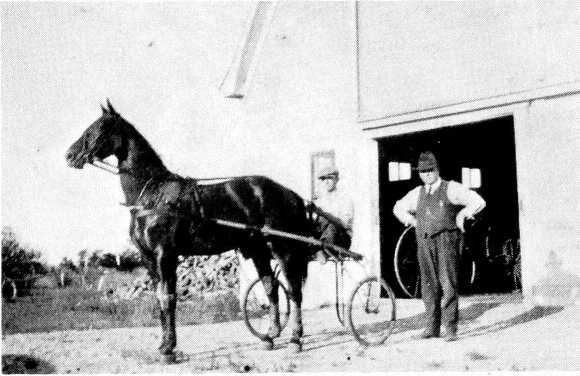
Country Jay is now an old horse but has raced and won on nearly all of the prominent tracks in the United States and is almost as widely known as Dan Patch. When a young horse he received a low record and then was retired for a number of years and as a "come back horse" surprised all horsemen by trotting to a record of 2:05 !4. He also trotted to a record under saddle of 2:08 Vz, which for a number of years was the world’s record. Mr. Dickson had purchased him for one of the lady drivers in his novelty race but the lady drivers could not handle him when racing. That he can still step some was shown at Rugby, when he won the novelty half mile race by trotting the half mile in 1:08.
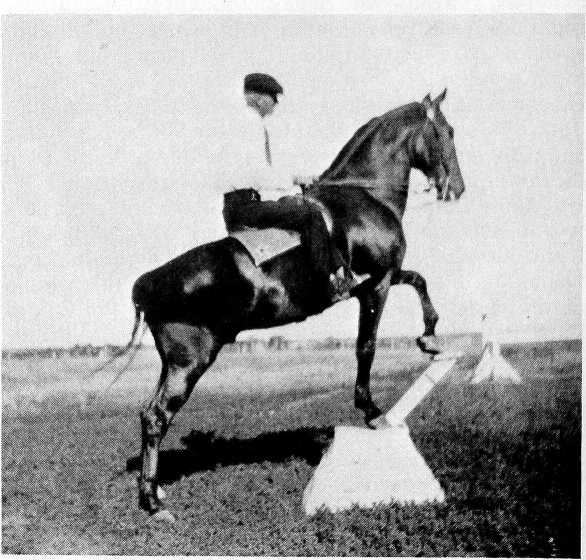
C. Willard Olson owned a trick horse named Franklin. When Willard was 18 years of age he trained this horse to do many exceptional tricks such as a 24 foot broad jump, a 6 foot high jump, marched to music, etc. Franklin performed at county fairs in Cavalier, Pembina and Towner counties. Willard also had the horse perform at many celebrations in the area. Franklin was sold to Orton Brothers Circus in the late 1920s.
In 1895, Samuel Eagelson bought a standard-bred pacer stallion from C. L. S. Hatch of Dallas, TX. It was on February 18th of that year that Sam took possession of "Woodbird" at Jacksonville, IL.
Although Sam used the stallion primarily for breeding, he did run the horse, though not officially. "Woodbird" was broke for the cart and Sam derived considerable pleasure in watching his neighbors start for town with their driving horses and then he would start out with "Woodbird" and pass them on the way to town.
Sam did race "Woodbird" against other local horses on the race track north of Milton but not in official races.
With quite a number of Milton area people being interested in race horses in the earlier days, it was only natural that a few local residents began to dream about having a race track at Milton.
In 1918, C. A. Olson, H. G. Halverson, W. Buchanan and J. W. Pratten made this dream a reality when they constructed a race track on land owned by C. A. Olson, just to the north of the Milton baseball diamond. Although there is little information concerning races or other activities that might have taken place there, it is known that in addition to horse races, there were also a few auto races held on this track.
The track apparently existed until the late 1920s when it once again became a part of C. A. Olson’s field land.
The Milton Globe was indeed pleased last week to learn that Milton had won a prize in the Cavalier County
Dog parade, sponsored by the Cavalier County Republican at Langdon, Saturday, May 14.
The prize was won by "Trixie," owned by W. P. Wild. The following paragraph was the Republican’s description of the local entry:
"Tommy Backes, 7-year-old youngster from Easby, led his Irish terrier Biddy, as old as the master himself, in the parade with every hope that the dog’s ‘Mick Mug’ would win him the prize for having the homeliest dog. The prize for homliness went to Trixie, the five-year-old mongrel led by three-year-old Billy Wild, Jr., of Milton. The judges agreed that the Irish terrier was naturally homely and was supposed to be but Billy’s dog, apparently a combination collie, police, daschound and terrier, was homely and couldn’t help it. He was not only homely and couldn’t help it, he was also misshapen."
By Charles Stabo
Tradgedy, hardships and sorrow have been a part of life for the human race since the beginning of time and the Milton area has had its share of each. From 1888 to 1937, the Milton Globe published hundreds of stories and news items concerning the misfortunes experienced by local individuals. However, along with all the "bad" news, there are also accounts which tell about the typical "rural community" neighborliness, love, sympathy, assistance and concern which was extended by friends and neighbors whenever someone experienced misfortune.
We wish we could publish all such stories but space will not permit this. Therefore, we present some representative stories which we encountered on our "trip" through the newspapers.
Horses and oxen were the cause of many painful accidents. Many people received severe facial cuts, broken legs and arms, as a result of being kicked by horses and runaways occurred frequently. The son of Vigfus Hanson was killed when his team ran away while he was mowing hay. John Einarson suffered severe foot and leg injuries when his horses ran away with a grain binder. In 1912, sixteen-year-old Johnnie Watt was badly injured when his riding horse fell on him.
Today, when we leave our vehicles, we usually put them in "park," take the keys and it stays there. To put a team of horses in "park" while in town, you could stable them at the livery barn or tie them to a hitching post in the "tying yard" north of the Milton depot or to hitching posts provided along the streets. There was a town ordinance against tying your team to a light pole because it damaged the pole. When H. E. Sunderland left his team and dray sleigh untied in front of the Northwestern Hotel one cold day, while he went in to enjoy a hot cup of coffee, he returned to find them missing. A hasty search found them enjoying the warm sun on the south side of the hotel. On a cold winter Saturday during the 1930s, James Gillespie offered to bring a team and sleigh to town and with the assistance of friends, was helping some lady teachers move from one place to another. When the sleigh was partially loaded, the team decided to go home withouttheir driver and breaking into a dead gallop, proceeded to scatter the teacher’s belongings across the countryside You had to put those horses in "park," too, and many drivers carried heavy weights provided with a ring, to which you could tie the horses.
Although they were slower animals, oxen also caused painful accidents. In 1894, Dr. Suter of Milton treated an arm injury for Mrs. Ole Nilsen Stabo which was caused by an ox hooking and running his horn through her elbow. In spite of Dr. Suter’s care, Mrs. Stabo had a stiff elbow the rest of her life.
In August of 1897, Harry Fergusun fell into a 30 foot well which he and "Jock" Roberts were digging inside John Wild’s barn. He suffered severe back injuries.
Mechanization and the coming of automobiles brought an increase in accidents. Ben Trompour suffered a broken leg in 1897 when he got caught in a belt and Bert Laing’s leg was badly hurt in 1912 when he attempted to push a blower belt back onto the pulley with his foot. Another young man, the son of Pete Wild, was killed when he tripped on the whistle rope while walking across the top of their steam engine and fell into the fly-wheel. When the steam engine owned by Pete Throndset blew up while threshing on the Wroolie farm, east of Milton, fireman Ole Mellum was badly scalded. In 1912, John Akset suffered a severe hand injury when his hand became caught in the gears of a grain elevator.
In March of 1912, Alex McKay suffered severe face and head injuries while he and John McLaurin were unloading a stump puller from a wagon and it slipped off the wagon wheel.
A great number of people were injured in runaways when their horses became frightened by the first automobiles. A. J. Austin’s Metz car was totally destroyed when it was struck by a train, just west of the Milton depot. Fortunately, no one was badly injured. This happened in 1915 and four years previous, in 1911, Bertha Koppang was killed when the Model T Ford she was riding in turned over near the McKechnie farm in Montrose Township.
The worst fatal accident in the Milton area occurred in November of 1945, when five young men from the Mountain-Hensel communities were killed at the highway bridge one-half mile north of Milton. Freeman Einarson Jr., Kenneth Lawonn, Wilfred Gilmore and Charles and Leonard Conlan all died when their car left the highway just before reaching the bridge and plunged over 40 feet to the dry river-bed below.
On September 21, 1971, Dale Goodman died instantly when his pickup collided in the darkness with a stalled truck on the new highway grade north of Milton.
Another tradgedy occurred in Milton in February of 1905, when two freight trains collided in the city and brakeman Hyrem Baker was killed instantly. Other members of the train crew, namely, Wilson, Hawkes, Baldwin and Frye were seriously injured. In 1913, a train brakeman slipped and fell under the wheels of the train and his one leg was badly mangled.
Lawyer W. J. Thompson died in Milton on May 11, 1899, from an accidental gun-shot when he and his partner, Lawyer George Gibson were examining a gun and it accidentally discharged.
Fires have also taken lives and destroyed property. Nine horses perished when the sod barn owned by Tom O’Rourke burned two miles southeast of Milton in 1889. In 1899, Tom Sadler’s barn burned and the Menes store building in Milton was badly damaged. The St. Anthony and Dakota elevator burned on January 6, 1901.
Two women burned to death the evening of January 17, 1902, at the "Dan Oakland’’ home one-quarter mile east of Milton. While her husband was in Milton delivering milk, Mrs. Lars Hanson poured kerosene on a coal fire to warm the house up and it exploded, setting her on fire. The Hansons had been married only a year, and her sister, Lottie Doty, a nurse from Chicago who had just arrived to visit, tried to put out the fire and carry her sister outside. Her clothes also caught fire and she ran outside calling for help. She again entered the house in a vain attempt to save her sister. Mr. Hanson returned about this time and his cries for help were heard by Mr. Goodbody who lived in the "Dell." He and others from town who had heard the cries arrived and got the fire out but both sisters died. The bodies were returned to their former home at Connesutville, PA, for burial by their brother who came to Milton when the tradgedy occurred.
Another fatal fire occurred on a Sunday afternoon late in the fall of 1920, when the farm home of Mr. and Mrs. Norman Olson burned to the ground in Section 12 of East Alma Township. Since Mr. Olson was away for the afternoon singing with a church choir, Mrs. Olson decided to go to the barn and feed some animals late in the afternoon. The two older sons accompanied her, leaving four younger children, Leonard and Doris, five-year-old twins, Helen, three, and Alice, five months, in the house. When Mrs. Olson looked toward the house a short time later, the house was in flames. Despite her desperate efforts to save the children, the flames drove her back and they perished.
There have been many fires through the years which have destroyed homes, barns and sheds and in several instances, people narrowly escaped being trapped in such fires.
One of the most disastrous fires in Milton occurred in December of 1904. Practically an entire business block was destroyed when an acetylene gas tank exploded in the rear of the H. Anderson billiard hall. Destroyed in the blaze was the Central Hotel, Anderson’s billiard hall, Reilly’s drug store, Plain’s furniture store, the Opera house and the K. P. Hall. Other buildings were threatened but assistance from a bucket-brigade saved them.
>H. E. Sunderland had a narrow escape in 1913 when his stove exploded and his clothing caught fire. Martin Johnson, who was passing by, ran to his rescue and succeeded in putting the flames out.
Milton suffered another great loss of businesses in October of 1914, when fire destroyed the Milton Motor garage, Menes building, bowling alley, Welo cottage, E. L. Peterson home and did extensive damage to the Milton Globe office.
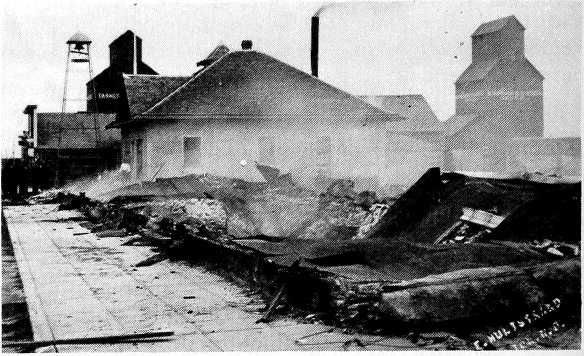
In 1919, the Milton Public School burned and this was replaced by the new brick school which is presently being used.
Other days of sorrow in the Milton area included a three-week period in February of 1920, during which time 11 residents died. Those who died were Sigvart Olson and his two sons, Ole and Melvin, Emiline Wold, Gerhard Flom, Jesse Bakken, Arthur Ehrhardt, John Watt, Chris Flom, Henry Nelson and one of Mr. and Mrs. Martin Skaro’s children. Others who died in this flu epedemic were Mr. and Mrs. Milton Wilson and one of their children and John Flack and his daughter, Winnifred. There were many other instances of tragedies, and hardships were often caused by stormy weather.
The Milton Globe reported a blizzard which struck the area on April 10, 1893, which left snow banks from 10 to 16 feet high in the city. A similar storm occurred during late winter of 1966 and the snow banks in Milton were just as high as the 1893 storm.
Another severe blizzard struck the area in March of 1902, and a man named LeLaney, who was well known at Milton as a stock buyer, froze to death west of Park River, when he became lost in the storm. Ten head of cattle strayed ahead of the storm from the Joe Slama farm and all perished.
The Milton area was also in the path of the killer storm which struck on March 15, 1941, taking 78 lives in North Dakota and Minnesota. Following a nice, mild, spring day, the storm roared in from the west in the evening, bringing zero visibility and sharply falling temperatures. Although many people in the Milton area had narrow escapes from death, no one from this area died.
The Milton community was staggered by a tornado which struck about 2:30 p.m. on Sunday, July 21, 1929. Damaging an area of from 10 to 15 miles in width, the storm moved in from the southwest, leaving destruction everywhere in its path. Although a crowd of people were attending a baseball game in Milton, the only known injury to humans was when a timber was blown into her farm home and struck Mrs. Ole Christianson, breaking her thigh bone.
In addition to uprooting trees, downing power and telephone lines and scattering hay stacks, several plate- glass windows were broken in Milton business places. Buildings sustaining damage in Milton included the cement-block building, Club Billiard hall, Green’s hardware, Robertsons Lumber Co., Farmer’s Union Elevator, Styrvocky’s blacksmith shop, the Lutheran church, the building owned by the Plain estate west of the Lutheran church and the Milton Globe office. Many residences including the Green and Asgrimson homes lost shingles and chimneys.
In the country, barns were lost on the A. F. Elliott farm, John Flack farm, Wm. Murta farm, P. A. Anderson and Alec Laing farms and half of the huge barn on the C. W. Plain farm. George Torkelson had his Ford coupe in his garage and the storm took the garage and left the Ford. Barns and other out-buildings were also lost on the farms of Stengrim Nelson, Sigvart Olson, N. L. Walstad, James Torrance, Martin Hanson, Ernest Meling, Andrew Flom, Bertha Flom, Joseph Tronset, Jens Nordquist, Earl Armstrong, Thomas Dennison, Jack Stewart, John Wild and Leo Wild.
Horses were trapped in barns on both the Bob Flack and Dr. Elliott farms and neighbors hastened to those farms to help in getting them out. All 10 horses in the Flack barn had to be pulled out by the men.
The storm was accompanied by some rain and hail and there was undoubtedly much more damage in the community than what was reported in this article which was taken from the Milton Globe.
On July 24, 1978, the Milton community suffered some damage when a tornado struck the Melvin Jenson farm south of Langdon and then moved in a northeasterly direction directly north of the Richard Otto and Sanders Bros, farms. Extensive damage was done at the Jenson farm and again at the Kent Brusseau farm, two miles west of Milton. The twister dissipated after striking the Brusseau farm.
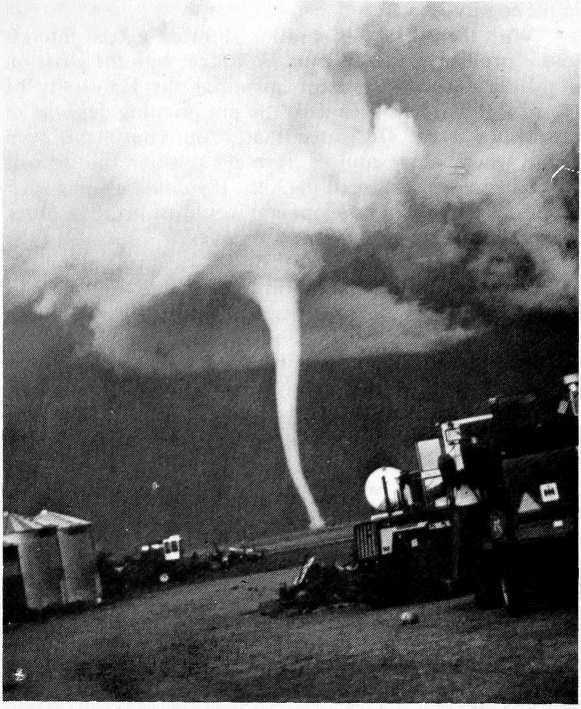
Throughout the history of this community, whenever people have been faced with adversities or sorrow, their neighbors have always moved quickly to aid them and to demonstrate their love and concern for their fellow men.
Written by Charles Stabo
One of mankind’s favorite dreams has been to "strike it rich’’ by finding gold, silver, other precious minerals or oil and a few succeeded. Once the early Americans learned that our land and our mountains concealed these rich deposits, the dream of wealth drove thousands of people to abandon all else in the search for a financial life of ease that such discoveries would bring.
The early discoveries of gold and silver sent thousands of prospectors into the wilds with pick and shovel, where they spent long, hard, lonely years in this quest but for each one who found a "mother lode" or in later years oil, hundreds and thousands failed. Those who failed usually turned to other occupations in these areas, and in so doing, helped to pioneer the country.
Although it was not the discovery of precious minerals or oil that brought the pioneers to the Milton area, such dreams have not been alien to the area residents. There have been reports from early days of finding coal and even gold but the wealth of this land has been and continues to be, the richness of our soil. If our area conceals anything of mineral value, the exact whereabouts remains a secret for future generations to dream about, with the exception of "fuller’s earth" and perhaps cement.
In 1937, a November issue of the Cavalier County Republican contained a story stating that the discovery of "Fuller’s Earth" in Cavalier County held some promise of the possible establishment of an "important new industry" in the county.
With the Filtrol Corporation showing a keen interest in this product, Prof. William E. Budge, with the Division of Mines and Mining Experiments at the University of North Dakota, had been active in pin-pointing deposits in the Milton area. He stated that, "outcrops have been found where water courses have cut through the deposit which lies near the base of the hills. It would be along such water courses where development would be made in order in have the least over-burden to remove.’’
Sites pin-pointed by Prof. Budge included, along the valley of the Little Pembina in South Olga, and also in East Alma and Montrose townships. He also believed there were more such outcroppings in the area.
Fuller’s earth is a yellowish substance which resembles clay in appearance, although it is more like a soft stone in substance. It feels slightly soapy to the touch. Commercially, fuller’s earth is used to reclaim oils, purify animal and vegetable oils and in refining crude oil. Samples of the clay were found to be excellent when they were assayed by the Filtrol Corporation. Satisfied with the quality of the samples, the corporation planned to determine the extent of the field and whether it is so imbedded that it could be economically excavated.
A short time later, there was some activity in attempting to "mine or remove’’ Fuller’s earth from Section 13 of East Alma Township. Some trail roads were dozed into the area and it is believed a few loads were removed. By the end of that summer, activity ceased and there had been no further action.
The discovery of cement prior to 1920, west of the village of Concrete, and the consequent development of a cement mine there, was responsible for some increased activity in that regard at Milton and in the Milton area, in fact a cement block factory was established at Milton. With South Olga Township bordering this old mine to the west, there is a distinct possibility that there are deposits of cement in that part of the Milton area.
However, the story about the cement mine will be presented in the "South Olga" part of this book.
The Milton area experienced a flurry of activity in regard to oil exploration during the 1950s. Although western Cavalier County had more "wildcat’ wells drilled, the Milton area had its share of activity. A former state geologist at one time pin-pointed an "anti-cline" running from northwest to southeast in Montrose Township. With formations such as Niobrara shale "pinching out" or surfacing in the Pembina Hills area, the oil companies were perhaps spurred on to explore by the thought of discovering shallow production, which is more profitable than deep drilling, as well as the possibility of finding pockets of "trapped oil." Although it is doubtful if any seismic testing was done in the Milton area, there was some testing done by flying over areas with a testing device which supposedly enabled the operators to prepare maps which would show areas of potential production.
Excitement increased as oil companies moved in and leased blocks of land. One of the companies who leased a block in the Milton community was the Powers Lake Petroleum Co. of Powers Lake, ND. George A. Vincent arrived in Milton and leased a block of land for this company. Many had hopes of "oil-wealth" coming to the community as the Wetch and Zachmeyer drilling company moved their rig to the W. W. Wild farm and "spudded in" on the southwest quarter of Section 21 the summer of 1956.
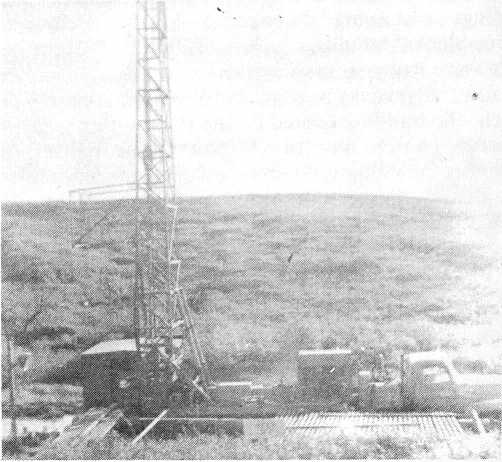
The W. W. Wild No. 1 was drilled to granite at a depth of 2,200 feet. Although it was reported that there were seven showings of oil in the Mississippian sand formation, between 1,110 and 1,522 feet, the well was abandoned. The company received permission to move about 25 feet north of this first well and drill the Wild No. I-A, with the intent of bringing in a "water-free" producer from the Mississippian formation, but this well also was abandoned.
During this drilling operation, a beef barbecue was sponsored by the Powers Lake Petroleum Co., and Mr. Wild, who donated an 800 lb. beef. Held on a Sunday afternoon, the beef barbecue plus 50 lbs. of hamburger and 40 lbs. of hot dogs was served to an estimated 2,500 people who visited the site that day. Members of the Milton Community club assisted in serving.
Some months later, another "wildcat" was drilled in Section 3 of East Alma Township on land then owned by Grimsi Goodman. This well also proved to be a "dry hole" and was plugged and abandoned.
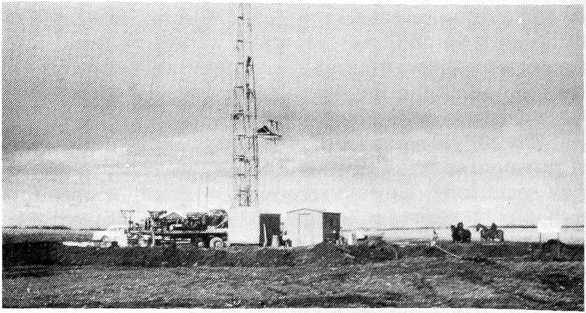
The history of the Milton area includes the names of many people, who stayed a short time and then moved on. Some of these people would be remembered by a few but there were those who were the "colorful type," who by their personality, were in sharp contrast to the average rank and file of people and thus are long remembered. Such a man was George Vincent.
George A. Vincent was born August 13, 1890, at Labette County, Kansas, one of twin sons of Noah W. and Nancy Vincent. Noah had migrated to Kansas after serving with the "Green Mountain Boys" from Vermont University in the Civil War. The Vincents had 12 children.
Following his graduation from high school, George moved into the oil fields of Oklahoma and Texas and through hard work, was rapidly promoted to positions of responsibility in the oil drilling business. He became a driller and trained two of his brothers, who later helped him drill many wildcat wells. George became an expert in all phases of the oil business from drilling to refining, and in 1920, was appointed Kansas State Conservation officer and as such was the only oil and gas inspector in the state, responsible for permits, testing and preserving geologicalrecords. He was a self-taught geologist due to his experience and when leasing or making royalty-purchases, made sure it was set up so that the owners shared in any good fortune.
During the thirties, George moved on to Colorado, Wyoming and eventually, the Williston basin. About 1950, he helped form the "Powers Lake Oil Company." As he leased for various companies, he would purchase "edge leases" and royalties for himself and use this to finance further oil ventures.
In the mid-1950s, he arrived at Milton and proceeded to lease a block of land for the "Powers Lake Oil Co.," and stayed in the area until he died at Park River, following a heart attack in February of 1957. He is buried in the Milton Memorial Cemetery.
George married Sellie Dunseth at Springfield, MO, in 1913. They had three children: Lee Paul, Max D. and Martha. Due to continued separation caused by George’s travels with the oil business, he and his wife were divorced in 1932.
George made many friends during his days at Milton and these friends provided a marker for his grave.
Compiled and written by Charles Stabo.
During the past one hundred years, Milton area people have always had a keen interest in politics and self-government. In earlier days, political conventions were >often held in Milton and several local men were elected to legislative offices.
The following is a list of Milton area men who have was served in the political field.
George H. Walsh, Republican, served as member of Territorial council (senate) at Yankton, SD, 1881; served in Territorial council at Bismarck, 1885 and 1889; and served as North Dakota Public Service Commissioner in 1891 and 1892.
John McBride, Democrat, member of North Dakota Constitutional Convention in 1889 and first senator elected by to North Dakota legislature from Cavalier County, 1889.
Joseph Powles, member of North Dakota Constitutional Convention, 1889.
Henry T. Helgeson, Republican, served as North Dakota’s first Commissioner of Agriculture and Labor, 1889-1892 and elected representative from North Dakota to U.S. Congress in 1910, 1912, 1914 and 1916.
Fred Dennett, Republican, served as representative to North Dakota state legislature in 1891.
Ole T. Axvig, Democrat, served as representative to North Dakota state legislature in 1891, 1901 and 1915.
Charles W. Plain, Democrat, switched to Republican, elected representative to North Dakota state legislature in 1892; elected to North Dakota state senate in 1895, 1897, 1903, 1907, 1909, 1911 and 1913.
John Flack, Democrat, elected representative to North Dakota state legislature in 1895.
John Butterwick, Fusionist, elected representative to North Dakota state legislature in 1897.
Sever Berger, Republican, elected representative to North Dakota state legislature in 1899.
W. E. Jennings, Republican, elected representative to North Dakota state legislature in 1905.
Mandus Hulstrand, Democrat, elected representative to North Dakota state legislature in 1937 and 1939.
Glen O. Goodman, Republican, elected representative to North Dakota state legislature in 1962, 1966 and 1968.
Albert Bowles, Democrat, elected representative to North Dakota state legislature in 1963 and 1965.
The following legislators lived very close to the Milton area and also had family ties to the Milton area.
Alfred N. Flom, elected representative to North Dakota state legislature in 1921, 1923, 1925, 1927 and 1929.
Howard Hove, Republican, elected representative to North Dakota state legislature in 1979.
F. O. Ottem, Republican, elected representative to North Dakota state legislature in 1951.
Gudmunder Grimson was born in Iceland in 1878 and came with his parents, Steingrimur and Gudrun Grimson, to this country in the early eighties. The family first lived with relatives in Gardar Township and later moved to a homestead in Cavalier County near Milton in 1886.
Gudmundur Grimson and Ina Sanford were married in August of 1916. They had two sons, Keith, a professor of surgery and medical research and Lynn, an attorney.
Gudmundur worked his way through the University of North Daktoa. Among other jobs he taught in the area country schools during the summer months and later studied law at the University of Chicago. He practiced law at Munich, ND, and published the Munich Herald from 1908 to 1912. He was elected states attorney of Cavalier County in 1910 and served in that capacity until 1924.
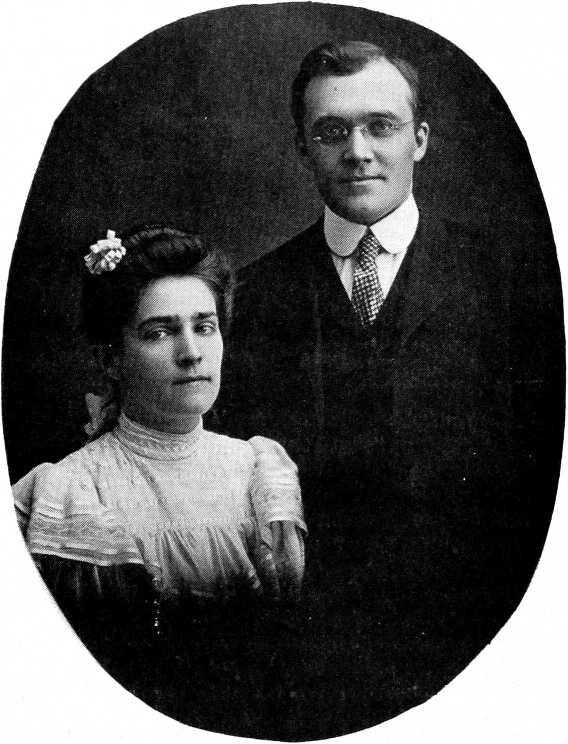
Mr. Grimson won national fame and the Pulitzer Prize for public service for his role in the investigation of the Martin Tabert case. This case involved the flogging death in a Florida lumber camp in 1922 of Martin Tabert, a young Munich, ND, farm boy. His courageous investigation resulted in the reform of prison laws in many parts of the United States.
He was appointed judge of the Second Judicial District of North Dakota and later he was appointed judge of the North Dakota Supreme Court. The University of North Dakota awarded him a second Doctor of Laws Degree in 1939.
Mrs. Grimson died in 1959, Judge Grimson died June 22, 1964.
By Charles Stabo
After reading the material concerning Ole T. Axvig, that was submitted to the Milton Historical Committee, it appears that it would have been a wonderful and interesting experience to have known Ole.
We know that Ole arrived at "Strate Post Office" in the early days and not only did he become the operator of that store and post office for a while, but he also married Mr. Strate’s daughter.
Ole later established a farm in Montrose Township adjoining Milton on the south and became the owner of a large amount of land. It is also rumored that when the railroad was built to Milton, Ole helped to build the grade, driving his team of white mules on a scraper.
According to the North Dakota ‘‘Blue Book," Ole was elected to the North Dakota House of Representatives in 1891, 1901 and 1915, on the Democratic ticket.
It appears that Ole was a man whose Norwegian heritage had left him with a very strong Norwegian accent and perhaps it was somewhat of a hindrance in being flowery and fluent with the English language. Newspapers such as the Fargo Forum, Grand Forks Herald, Bismarck Tribune and the Minneapolis Journal, even commented on his beard and his manner of dress but they also soon realized that Ole was a man to be reckoned with. One newspaper even made reference to Ole being ‘‘addicted to the flowing bowl, to a moderate extent."
Ole’s well-dressed, educated and fluent counterparts in the legislature soon learned however, that when legislation came before the house, Ole was better acquainted with the facts than they were and his strong character and desire to serve those who had elected him, made him a formidable figure in North Dakota politics.
Described as "a veritable granger" when he first attended the legislature, the Bismarck Tribune reporter described Ole’s expressions when he presented a pet bill for consideration. We quote, "If the remarks are favorable, Ole’s smile turns into a broad grin, and if opposed, a frown begins to gather. When the measure is crucified, Ole sits back with an expression that seems to say, ‘forgive them, they know not what they do.’ " The Tribune went on to predict that everyone had better keep "their eye peeled for Ole," because they were sure he would come out of the legislature with one of the best records for honest and beneficial work.
Ole’s accent, honesty, shrewdness, and dedication to "serve the masses rather than the classes," obviously endeared him to the members of the press, as articles about him were always appearing in the larger newspapers.
About 1890, it was customary for the railroad to issue passes to prominent people and we quote the following story about Ole, who was on his way to the legislature at Bismarck in 1891 and not having a pass, he decided to try to get one. When he reached Larimore, he sent a wire to James J. Hill and simply stated, "I am here," and signed it, "Ole," An hour and a half later, a telegram came back from St. Paul saying, "I am here, too." and it was signed by James J. Hill.
We include a picture of Ole’s pass to show that his strategy worked!
Ole’s honest hard work and colorful personality made him famous to the point where our well-known North Dakota poet, James W. Foley wrote the following poem about the incident when one of Jim Hill’s locomotives or "inyines" hit and killed Ole’s calf. It was published in the Saturday Evening Post.
At one time Ole introduced a bill in the legislature which would require railroads to establish stations at all points where their railroad crossed into Canada. Olesecured passage of this bill in the house and when it reached the senate, the railroads vigorously opposed the bill and finally agreed to establish stations where needed.
Armed with this promise, Ole and other officials met with representatives of the railroad at the Fleming farm in Section 36 of Fremont Township of Cavalier County. Farmers were also present and stated a need for the staion. The area had for some time been known as "Elm Point," but Ole was given the privilege of naming this new town since he had secured the legislation, and he named it "Tipperary."
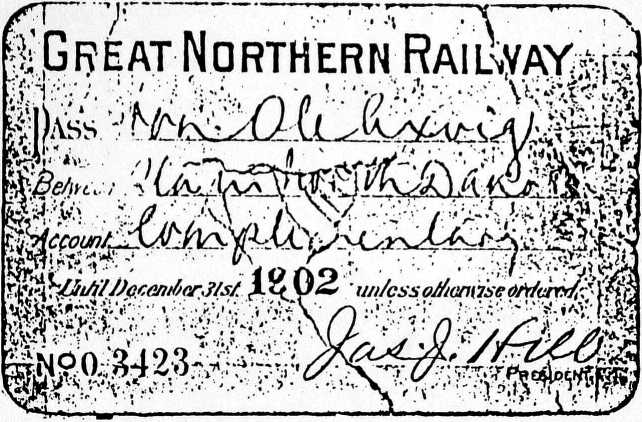
The following poem was written by Jimmie Foley, the well known North Dakota poet, on James J. Hill and our own Ole Axvig here in Milton. It was clipped from a recent issue of the Saturday Evening Post, the magazine that has a circulation of twice that of any other paper or magazine in the world. Who says, Ole isn’t getting famous.
Ve got little faller har, name ban Yem;
Das whole ralroad over har Belong to hem.
Beld it purty dogggone kvick
From San Pol to Passafick,
An he turn kvite many trick,
Das same Yem.
Fallers laugh ven he come har, Das man Yem;
But he ain’t ban fraid for scare, Not for hem.
Call das ralroad strak o’rust
An say Yem vill go clean bust;
But he keep still an he yust Vaik for Yem.
Val, Ay tal you Ay don laugh, Ay explode,
Van his inyine kal my calf On das road;
An Ay shak my fist an svar
At das doggone inyinaar
An Ay vish das Yem ban har Van Ay knowed.
An Ay say my calf ban kal On das track;
Ay skol fight das man Yem Hal. Ay don lak
Suts a tang as das, Ay say,
Tak das ralroad kvick avay,
An das oxcart he skol stay, Breng hem back.
Val Ay wrote das note to hem On das calf;
An a faller har say Yem Had big laugh;
And he wrote me too An say: "Ole, Ay lak you,
An how much you tank ban due On das calf."
Val, das calf ban purty fine (Van hees dead).
An Ay wrote das Yem a line An Ay said:
"Ay vill let das ralroad run For tan doller in gude mun — Das calf vod have veighed a ton Yust lak lead."
Val, Ay got my gude hard mun From das Yem,
An Ay lat das ralroad run Yust for hem;
An Ay tank das Nortvest har Yump ahead gude many yar Yust by not ban fraid for scare, Me an Yem.